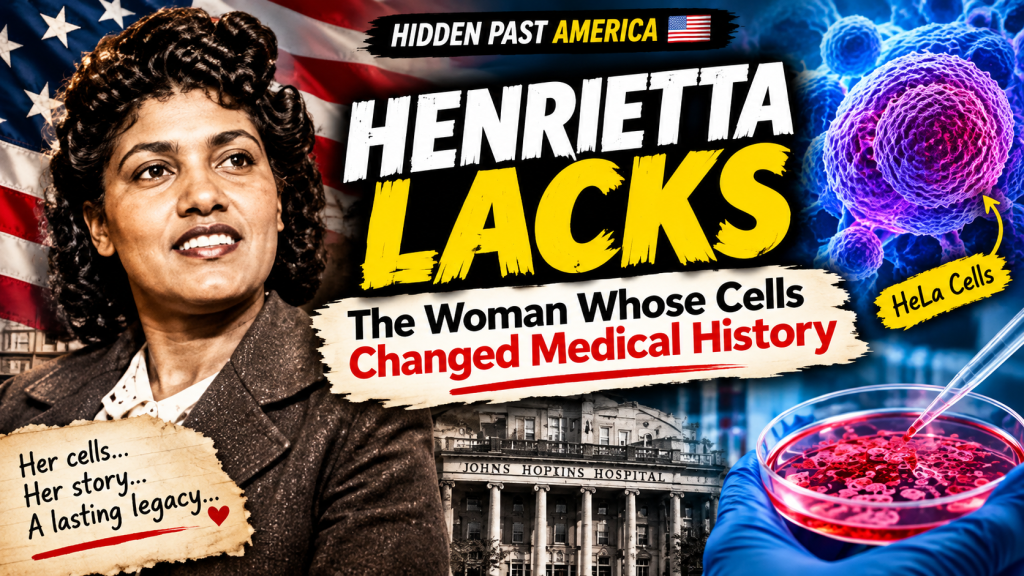
The True Story Behind HeLa CellsIn 1951, a 31-year-old woman named Henrietta Lacks went to Johns Hopkins Hospital in Baltimore, Maryland, for treatment of cervical cancer.She could not have known that cells taken from her tumor would later become one of the most important tools in modern biomedical research.Those cells became known as HeLa cells—named using the first two letters of Henrietta’s first and last names. Unlike most human cells grown in laboratories at the time, they continued to grow and divide.But behind this scientific breakthrough was a deeply personal story involving Henrietta, her family, medical research, and questions about consent.A Woman Seeking TreatmentHenrietta Lacks was an African-American woman living in the United States. In early 1951, she sought medical treatment after experiencing symptoms that led doctors to discover cervical cancer.At Johns Hopkins Hospital, doctors treated her cancer and took a biopsy of the tumor.A portion of the tissue was provided to the laboratory of researcher George Gey, who had spent years trying to grow human cells outside the body. Most of the cells his laboratory received died quickly.Henrietta’s cells were different.They continued to grow and multiply in laboratory conditions. �Hopkins MedicineThe Cells That Would Not Stop GrowingThe cells eventually became known as HeLa cells.Scientists had previously struggled to maintain human cells for long periods outside the body. HeLa changed that.The cells could be multiplied and shared with laboratories around the world, giving researchers a powerful way to study human biology and disease. �Hopkins Medicine +1In 1952, researchers established HeLa cells as a continuously growing human cell line.This became a major turning point in laboratory research. �Office of Science PolicyHenrietta Never Knew What Happened to Her CellsOne of the most important parts of Henrietta Lacks’ story is also one of the most difficult.The cells were taken and used for research without Henrietta’s knowledge or consent. At that time, the rules governing informed consent and the use of patients’ biological samples were very different from today’s standards. �Stage Test Domain 3 +1Henrietta died on October 4, 1951, at the age of 31.Her life had ended, but the cells taken from her tumor continued to live and multiply in laboratories.That contrast became one of the defining parts of her story.How HeLa Cells Helped Medical ResearchHeLa cells became an important laboratory tool used in research around the world.Scientists used them to study cancer, viruses, radiation, drugs, toxins, hormones and other biological processes. They also played an important role in research connected to the development of the polio vaccine. �Hopkins Medicine +1Over the decades, research involving HeLa cells expanded into many different areas of biomedical science.According to the National Institutes of Health, its analysis found more than 110,000 scientific publications citing HeLa cells between 1953 and 2018. �Office of Science PolicyThat number shows how widely these cells have been used in scientific research.The Story Became an Ethical DebateThe scientific importance of HeLa cells did not erase the questions surrounding Henrietta’s story.For decades, many members of the Lacks family did not fully understand what had happened to Henrietta’s cells or how widely they were being used.As scientific technology developed, new questions emerged about privacy, consent and genetic information.In 2013, the National Institutes of Health reached an agreement with members of the Lacks family concerning access to certain genomic data from HeLa cells. The agreement created a system involving family participation in decisions about access to the data. �Stage Test Domain 3 +1The story therefore became more than a story about scientific discovery. It also became an important part of discussions about medical ethics and the rights of patients and their families.A Legacy That Continued After Her DeathHenrietta Lacks died more than seven decades ago, but her contribution to biomedical research continues to be discussed and studied.Johns Hopkins says HeLa cells have contributed to research involving cancer, viruses, radiation, the human genome and vaccines. �Hopkins MedicineHer story has also reached millions of people through books, documentaries, educational programs and other media.Rebecca Skloot’s 2010 book, The Immortal Life of Henrietta Lacks, brought widespread public attention to Henrietta’s life, her family and the history of HeLa cells. �Hopkins MedicineWhy Henrietta Lacks’ Story Still MattersThe story of Henrietta Lacks contains two very different sides of medical history.On one side is an extraordinary scientific discovery: cells from one patient became a powerful research tool used by scientists around the world.On the other side is the story of a woman who did not know that her cells would become part of scientific history.Her story reminds us that scientific progress is not only about what researchers discover. It is also about the people whose lives and biological materials make that research possible.Henrietta Lacks was more than the name behind a laboratory cell line.She was a mother, a daughter, a wife and a person whose life became unexpectedly connected to one of the most important chapters in modern medical research.Her cells changed science. Her story changed the conversation about medical research and consent.SourcesNational Institutes of Health — HeLa Cells and the legacy of Henrietta Lacks. �Office of Science Policy +1Johns Hopkins Medicine — The Legacy of Henrietta Lacks. �Hopkins Medicine +1National Institutes of Health — NIH/Lacks Family genomic-data agree
Henrietta Lacks — The Woman Whose Cells Changed Medical History


Leave a comment