
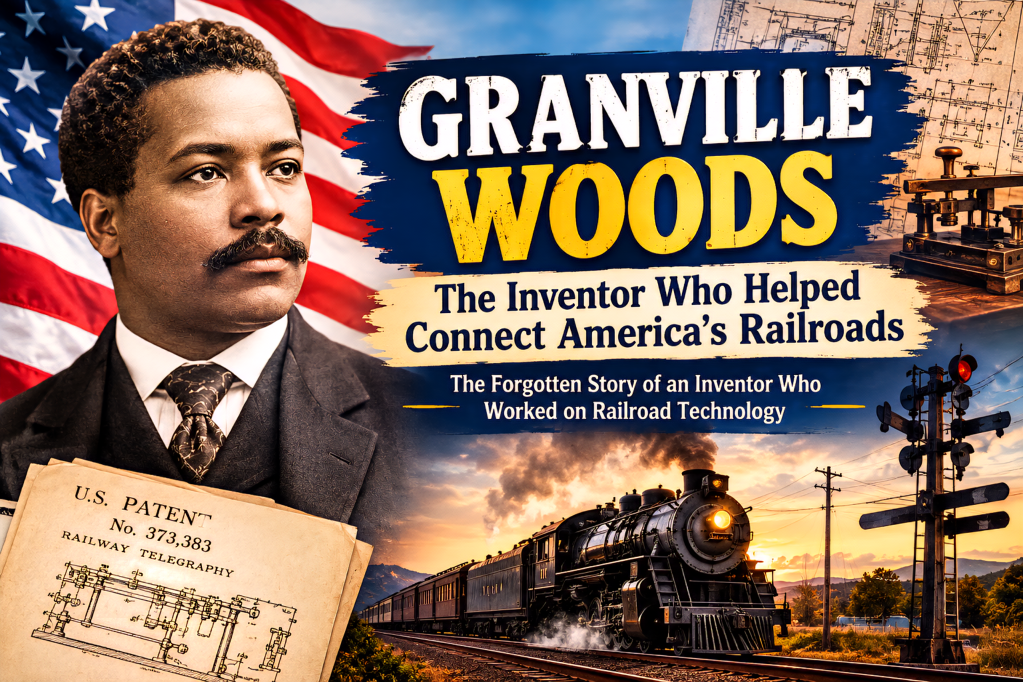
The Forgotten Story of an Inventor Who Helped Improve Railroad Communication
Granville Woods — The Black Inventor Who Worked on Railroad Technology
In the late 1800s, American railroads were expanding rapidly.
Trains were traveling longer distances, carrying passengers, goods, and mail across a growing nation. As railroad networks became larger and more complicated, communication between trains and railway stations became increasingly important.
One inventor who worked on this challenge was Granville T. Woods.
Today, his name is not as widely remembered as some other American inventors of his era. Yet Woods received numerous patents and developed technologies connected to electrical communication and railroads.
A Young Man Fascinated by Machines
Granville T. Woods was born in 1856 in Columbus, Ohio.
He gained practical experience working with machinery and railroads before developing his own inventions. Those experiences helped him understand the kinds of problems faced by workers operating America’s rapidly expanding railway system.
Railroads depended on much more than powerful locomotives. They also needed signals, switches, communication systems, and careful coordination.
Woods became particularly interested in the electrical and mechanical problems surrounding transportation.

From Railroad Work to Invention
Woods eventually became an independent inventor.
During his career, he received numerous patents covering electrical and mechanical technologies. Some of his most important work involved railroad communication.
Rather than focusing only on inventions that were impressive on paper, Woods worked on practical problems.
One major challenge was communication with trains while they were moving.
The Challenge of Communicating With Moving Trains
Imagine traveling by train in the 1880s.
A train could be miles away from a railway station, while railroad workers at the station still needed information about what was happening along the line.
Telegraph technology had already transformed long-distance communication. But communicating with a moving train presented another technical challenge.
Woods worked on ways to make railway communication more useful.
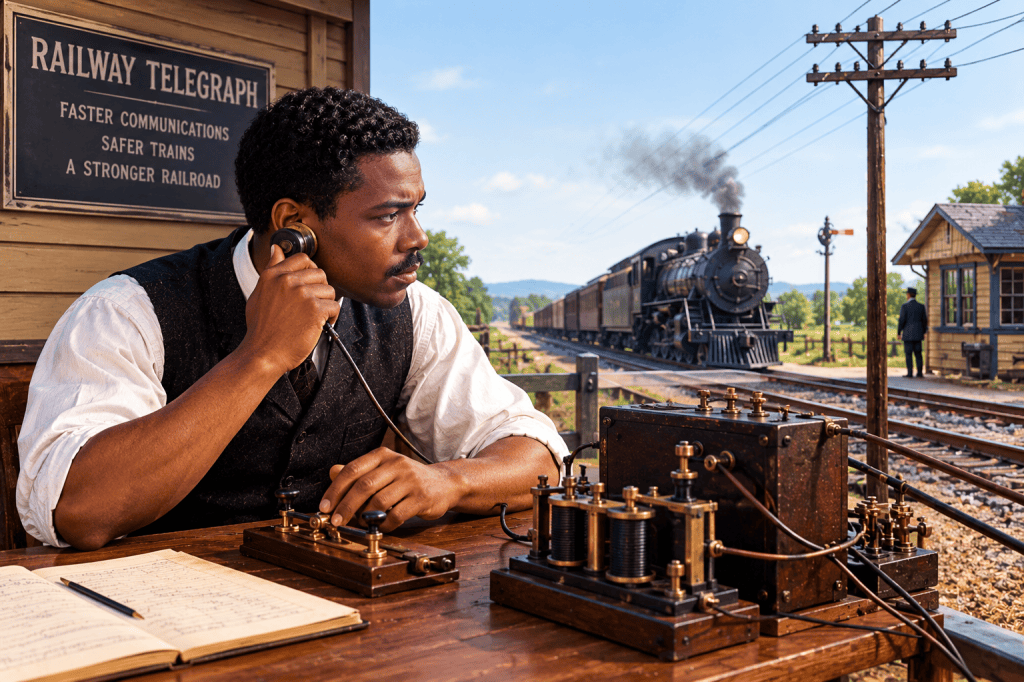
The Railway Telegraph
In 1887, Woods received a patent for a railway telegraph system.
The technology was designed to help communication take place between moving trains and railway stations.
This was important because better communication could help railroad workers coordinate train movements and exchange information more efficiently.
Woods’ railway telegraph work became one of the best-known parts of his inventive career.
More Than One Invention
Granville Woods was not a one-invention inventor.
Over the course of his career, he developed numerous technologies and received many patents.
His work included inventions related to railway communication, electrical systems, and other mechanical technologies.
His career shows how inventors often worked across several connected fields rather than concentrating on just one problem.

Working During a Difficult Era
Woods was developing his inventions during a period when Black Americans faced widespread discrimination in the United States.
Despite the barriers of his era, he built a career around engineering and invention,
His patents became part of the larger story of American technological development.
In 2006, Woods was inducted into the National Inventors Hall of Fame, helping bring additional recognition to his contributions.
A Name Hidden in Railroad History
When people think about the history of American railroads, they often remember locomotives, famous railroad companies, bridges, and major railway routes.
But railroads also depended on less visible technologies.
Communication was one of them.
A powerful locomotive could move people and goods, but the railroad system also needed reliable information and coordination.
Granville Woods worked on this important part of railroad technology.

His Legacy
Granville T. Woods died in New York City on January 30, 1910.
He left behind a substantial record of patents and inventions.
His work became part of the history of American electrical and railroad technology, and his story has since received recognition from institutions dedicated to preserving the history of invention.
Woods’ story is a reminder that technological progress is often built by people whose names are not always remembered by the public.
Some inventors worked quietly on practical problems that affected everyday life.
Granville T. Woods was one of them.
His work connected electricity, communication, and America’s growing railroad system—and his contribution remains an important part of American invention history.
Sources
• National Inventors Hall of Fame – Granville Woods – Biography and information about his railway telegraphy and patents. National Inventors Hall of Fame
• Smithsonian Institution – Granville T. Woods – Historical information about his life, inventions, and railway telegraph. Smithsonian Institution • Smithsonian Lemelson Center – Losi Histories of African American Inventors – Information about Woods’ 1887 railway-telegraph patent. Smithsonian Lemelson Center
• U.S. Patent No. 373,383- Railway Telegraphy – Original U.S. patent record, dated November 15, 1887. U.S Patent 373,383


Leave a comment