
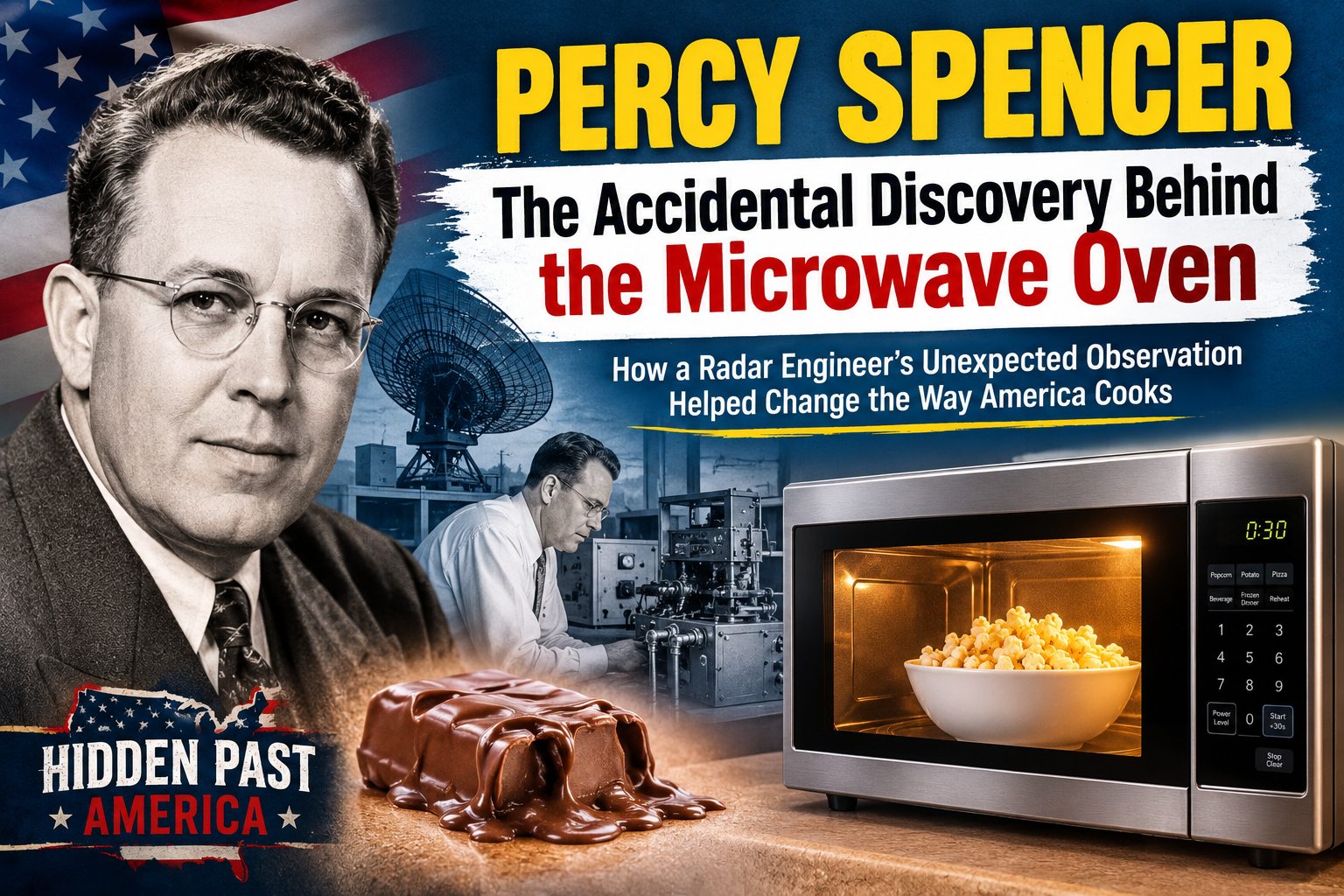
How a Radar Engineer’s Unexpected Observation Helped Change the Way America Cooks
A microwave oven is an ordinary part of many kitchens today. With the push of a button, people can heat leftovers, make popcorn, or warm a drink in just a few minutes.
But the technology behind the microwave oven has an unusual history.
It is closely connected to radar technology developed and improved during the years of World War II. At the center of this story was an American engineer named Percy Spencer, whose curiosity about an unexpected laboratory incident helped lead to a completely new way of heating food.
His story is a powerful example of how innovation can begin with something as simple as asking, “Why did that happen?”
A Young Man With a Passion for Technology
Percy LeBaron Spencer was born in Maine in 1894. His childhood was difficult, and he had limited formal education.
Despite those challenges, Spencer developed a strong interest in electricity, machinery, and technology. He taught himself many technical skills and eventually built a successful career in electronics.
His practical understanding of engineering eventually brought him to the Raytheon company, where he worked with advanced electronic equipment.
His career would become particularly important during World War II.
Radar and the Magnetron
During World War II, radar technology became extremely important. Radar systems helped military forces detect and locate aircraft and ships.
One of the critical components of many radar systems was the magnetron, a device capable of producing high-frequency electromagnetic waves.
Spencer became deeply involved in magnetron technology.
He helped improve the production of magnetrons so they could be manufactured more efficiently for the Allied war effort. His work contributed to the large-scale production of radar equipment during the war.
But while working with this technology, Spencer noticed something completely unexpected.
The Mystery of the Melted Candy Bar
In 1945, Spencer was working near an active magnetron when he noticed that a candy bar he had with him had melted.
The observation caught his attention.
Instead of simply cleaning up the melted candy and continuing his work, Spencer began wondering whether the microwave energy produced by the magnetron had caused the candy to heat up.
This was an important moment.
The discovery did not come from a carefully planned experiment. It began with an unexpected observation.
But Spencer understood that unexpected results can sometimes lead to important questions.
So he decided to investigate.
Experimenting With Food
Spencer began conducting experiments to determine whether microwave energy could heat food.
One of his experiments involved popcorn. When popcorn kernels were exposed to microwave energy, they became hot and popped.
He also experimented with an egg. The egg became heated so quickly that it eventually burst.
These experiments gave Spencer evidence that the energy produced by the magnetron could be used to heat food.
The idea was fascinating, but turning it into a practical machine would require much more work.
From an Experiment to a New Technology
Spencer and other engineers at Raytheon began exploring ways to use microwave energy for cooking.
The challenge was to develop a controlled system that could direct microwave energy toward food.
In 1945, Spencer filed a patent application describing a method of heating food using high-frequency electromagnetic energy. The patent was later granted in 1950.
This was an important step in transforming an unusual laboratory observation into useful technology.
Spencer’s work demonstrated that microwave energy, originally associated with radar systems, could have an entirely different application.
It could heat food.
The First Microwave Ovens Were Enormous
Modern microwave ovens are compact appliances that can sit on a kitchen counter.
The earliest machines were very different.
They were extremely large, heavy, and expensive. Some early commercial models were around six feet tall and weighed hundreds of pounds.
These machines were not designed for the average family kitchen.
Raytheon’s early commercial microwave oven became known as the Radarange. In 1947, an early unit was purchased by a restaurant in Cleveland for about $3,000.
At the time, that was an enormous price for a cooking appliance.
The technology clearly had potential, but it still needed to become smaller, more affordable, and more convenient.
From Radar Technology to the Kitchen
The story of the microwave oven is an interesting example of technology moving from military research into everyday civilian life.
During World War II, magnetrons were important components of radar systems.
After the war, engineers and companies explored peaceful applications for technologies that had been developed or improved during wartime.
Microwave cooking became one of those applications.
A technology originally connected to detecting aircraft and ships was eventually transformed into something people could use to prepare food.
That transition shows how scientific discoveries can have unexpected futures.
Percy Spencer Was More Than the Microwave
It is easy to remember Percy Spencer only because of the microwave oven.
However, his engineering career was much broader.
His work on magnetrons contributed to wartime radar production, and he was involved in other important electronic developments.
During World War II, Spencer also worked on technologies related to proximity fuses used with artillery shells.
His contributions to wartime technology were significant, and he received recognition from the U.S. Navy for his service.
The microwave oven was therefore only one part of a much larger engineering career.
Why His Discovery Matters
The most interesting part of Spencer’s story may not be the microwave oven itself.
It is the way he reacted to an unexpected result.
A melted candy bar could easily have been ignored.
Instead, Spencer became curious.
He asked what might have caused it.
Then he tested his idea.
The popcorn experiment provided another clue. The egg experiment provided another.
Through continued experimentation and engineering, an unexpected observation became the foundation for a practical technology.
This is one of the most important lessons in innovation: a discovery may begin with an accident, but turning that discovery into something useful requires curiosity, testing, and engineering.
How the Microwave Became an Everyday Appliance
The microwave oven did not immediately become a common household appliance.
Early models were too large and expensive for most families.
Over time, however, manufacturers developed smaller and more practical designs.
By the 1950s, microwave ovens suitable for home use were beginning to appear.
As the technology improved and prices eventually became more accessible, microwave ovens became increasingly familiar in American homes.
Today, millions of people use microwave technology without thinking about its unusual origins.
A simple kitchen appliance has roots in advanced radar research and the work of an engineer who noticed that a candy bar had unexpectedly melted.
The Legacy of Percy Spencer
Percy Spencer died in 1970, but the technology associated with his work continued to develop.
Today, the microwave oven is one of the most recognizable examples of an invention that grew from an unexpected observation.
Spencer’s story reminds us that important ideas do not always arrive exactly as planned.
Sometimes innovation begins when someone notices something unusual and decides not to ignore it.
A melted candy bar led to a question.
That question led to experiments.
The experiments contributed to a technology that eventually changed kitchens around the world.
A Small Observation With a Huge Impact
Percy Spencer’s story is more than the story of how a microwave oven was developed.
It is a story about curiosity.
He could have ignored the melted candy bar and moved on with his work. Instead, he investigated.
That simple decision helped open the door to a new application for microwave technology.
The next time a microwave oven quietly heats a meal in just a few minutes, it is worth remembering the engineer who looked at an unexpected result and asked a simple but important question:
“Why did that happen?”
Sometimes, that question is where innovation begins.
Sources
Smithsonian Institution, Lemelson Center — Research and historical information on Percy Spencer and microwave technology.
Smithsonian National Museum of American History — Historical information about early microwave ovens.
U.S. Patent No. 2,495,429 — Percy L. Spencer, Method of Treating Foodstuffs.
Leave a Reply