
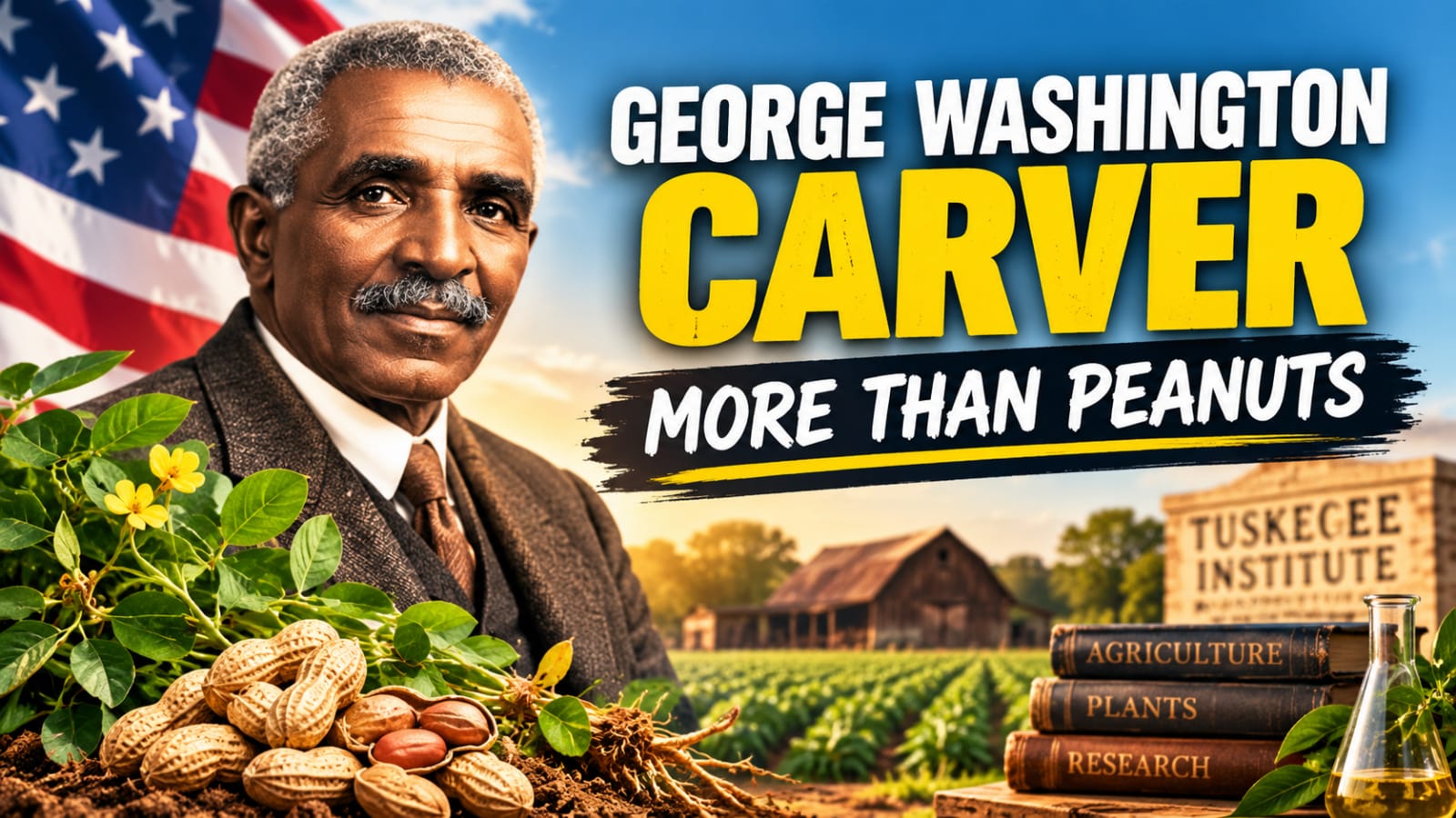
When people hear the name George Washington Carver, many immediately think of peanuts.
But Carver’s story was much bigger than one crop.
He was an agricultural scientist, teacher, researcher, and educator whose work focused on helping farmers make better use of the land around them. His life journey took him from slavery in Missouri to the classrooms and laboratories of Tuskegee Institute in Alabama.
His story is one of education, determination, science, and service.
A Difficult Beginning
George Washington Carver was born into slavery in Missouri during the final years of the Civil War.
As an infant, Carver and his mother, Mary, were kidnapped and taken away from the farm where they lived. People searching for them eventually found the young George and returned him to the Carver family. His mother was never found.
Carver grew up on the farm of Moses and Susan Carver.
As a child, he developed a deep interest in plants and nature. He spent much of his free time studying flowers, trees, and other plants. His knowledge became so noticeable that people in the local community began calling him the “Plant Doctor.”
That childhood curiosity would become the foundation of his future career.
Education Became His Path Forward
Carver wanted to learn, but educational opportunities for Black students were extremely limited during that period.
He traveled to different places in search of education and eventually attended Simpson College in Iowa, where he initially studied art.
His interest in plants and science eventually led him to Iowa State Agricultural College, now known as Iowa State University.
In 1894, Carver earned a bachelor’s degree in agriculture. Two years later, he earned a master’s degree in agricultural science.
He had overcome enormous barriers to reach that point.
But his greatest work was still ahead of him.
A New Beginning at Tuskegee
In 1896, Booker T. Washington invited Carver to lead the agriculture department at Tuskegee Institute in Alabama.
Carver accepted the position and remained at Tuskegee for the rest of his professional life.
For approximately 47 years, he taught students and conducted agricultural research.
But Carver did not want science to remain inside a laboratory.
He wanted farmers to benefit from it.
Helping Farmers Improve the Soil
At the time, many Southern farmers depended heavily on cotton.
Growing the same crop repeatedly could contribute to declining soil fertility. Carver promoted crop rotation and encouraged farmers to consider alternative crops such as peanuts, sweet potatoes, soybeans, and other plants.
The idea was simple but important: farmers could protect their land while also creating additional sources of food and income.
Carver studied plants not only to understand them scientifically, but also to discover practical ways they could benefit everyday people.
Why Peanuts Became Famous
Carver became especially well known for his experiments with peanuts.
He investigated ways peanuts could be turned into different food, agricultural, and industrial products.
His work demonstrated that a crop could have many possible uses.
Historical sources credit Carver with developing hundreds of potential uses for peanuts and other crops. His research also explored sweet potatoes and numerous other agricultural products.
However, the peanut was never the entire story.
Carver’s larger message was about diversifying agriculture and making better use of natural resources.
Bringing Education to Farmers
Carver understood that many farmers could not travel to Tuskegee to attend classes.
So agricultural education had to reach them.
One important example was the Jesup Wagon, part of the movable-school effort associated with Tuskegee.
The wagon carried agricultural information and equipment into rural communities. Farmers could learn about crops, farming methods, nutrition, and other practical subjects without having to travel to the college.
This reflected one of Carver’s strongest beliefs:
Knowledge was most valuable when it could improve people’s lives.
More Than an Inventor
Carver’s reputation sometimes became focused almost entirely on the number of products associated with peanuts.
But describing him simply as a peanut inventor misses the most important part of his work.
He studied agriculture.
He taught students.
He encouraged farmers to protect their soil.
He promoted alternative crops.
And he worked to make scientific knowledge useful to people who needed it.
His research involved peanuts, sweet potatoes, soybeans, cotton, and many other plants.
His work also demonstrated how agriculture could connect science with everyday life.
A Life of Service
Carver received recognition during his lifetime, but he remained deeply connected to teaching and research.
He believed education could give people greater independence.
At Tuskegee, he spent decades sharing his knowledge with students and farmers.
His work became an important part of the history of American agricultural science and African American education.
The Legacy He Left Behind
George Washington Carver died on January 5, 1943, at Tuskegee, Alabama.
Later that year, Congress authorized the creation of George Washington Carver National Monument in Missouri.
The site became an important national memorial to his life and achievements and preserves the area connected to his childhood.
Today, Carver is remembered not simply because of his work with peanuts, but because of the broader idea behind his career.
He believed that science, education, and agriculture could work together to improve people’s lives.
The Real Story Behind “More Than Peanuts”
George Washington Carver’s name is often associated with a single crop.
But his real contribution was much larger.
He showed farmers that the land could be treated as something to understand and protect.
He showed students that education could open doors that once seemed impossible to reach.
And he showed that scientific knowledge becomes especially powerful when it is used to help ordinary people.
Carver’s journey from slavery to respected scientist and educator is one of the remarkable stories in American history.
His legacy is not simply about peanuts.
It is about curiosity, education, perseverance, and using knowledge to serve others.
Sources
National Park Service — George Washington Carver National Monument
National Park Service — George Washington Carver, Tuskegee Institute National Historic Site
National Park Service — George Washington Carver biography
Smithsonian National Portrait Gallery — George Washington Carver
Iowa State University — College of Agriculture and Life Sciences History
Leave a Reply