
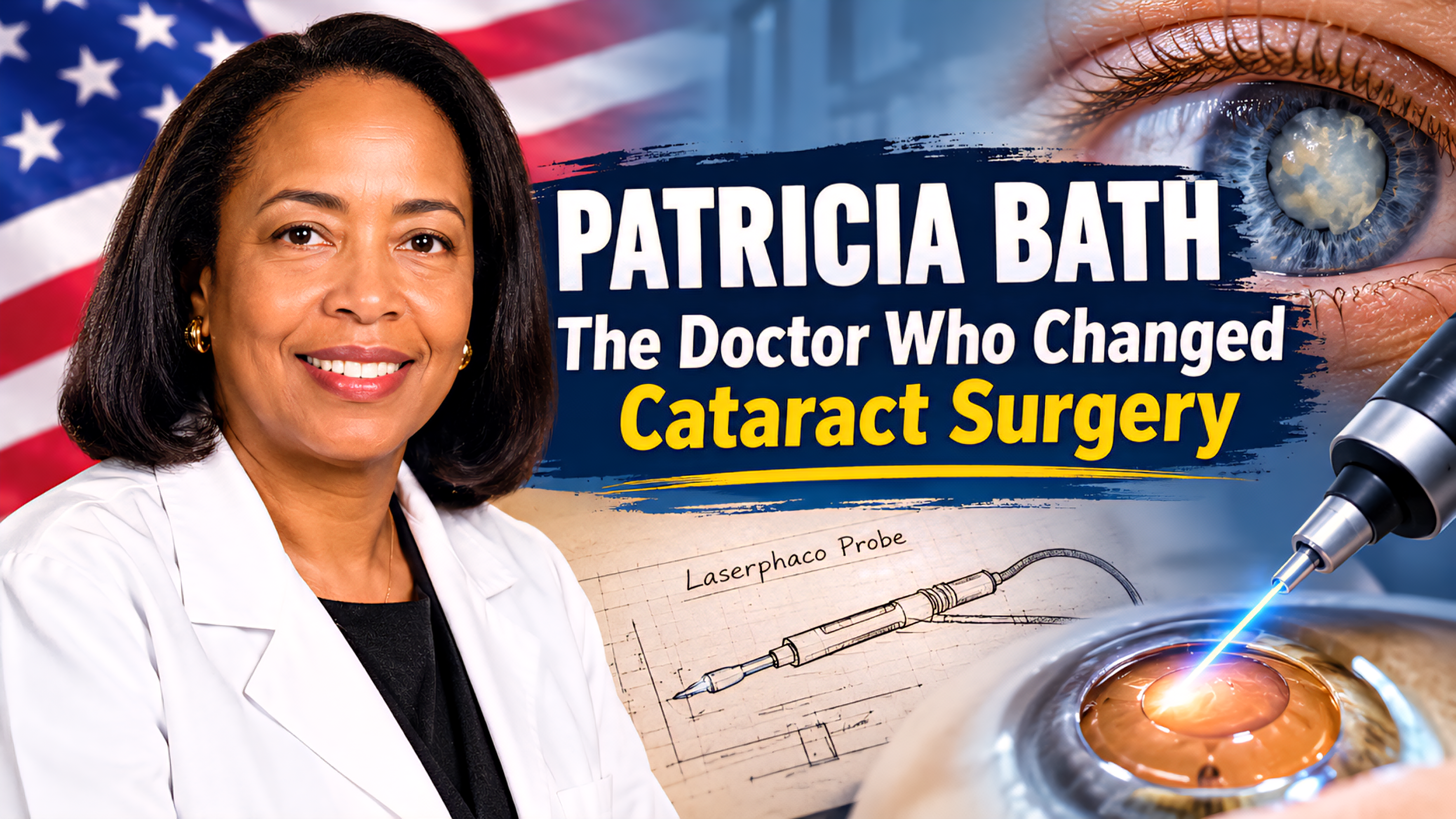
How an American ophthalmologist turned an idea into a pioneering laser technology for treating cataracts
For many people, losing their vision can mean losing independence, work, and the ability to experience everyday life normally.
Dr. Patricia Bath believed that blindness should not simply be accepted as a part of life.
An American ophthalmologist, researcher, and inventor, Bath devoted much of her career to improving eye care. Her work eventually led to the development of the Laserphaco Probe, a pioneering technology designed to use laser energy in cataract surgery.
Her story was not only about medicine. It was also about persistence, scientific curiosity, and the determination to keep working when new ideas were difficult to develop.
From New York to Medicine
Patricia Era Bath was born in 1942 in New York City.
From an early age, she showed a strong interest in science and medicine. Her ambition to become a physician was encouraged by her family and inspired in part by the humanitarian work she learned about as a young person.
She eventually studied medicine at Howard University College of Medicine and began building a career in ophthalmology.
Her path was not always easy. Bath encountered barriers related to both race and gender during her medical and scientific career.
Nevertheless, she continued moving forward.

Breaking New Ground in Ophthalmology
Bath became a trailblazer in American medicine.
In 1974, she became the first woman ophthalmologist appointed to the faculty of the UCLA Jules Stein Eye Institute. In 1983, she became the first woman in the United States appointed to chair an ophthalmology residency program.
But Bath wanted to do more than build a successful medical career.
She was deeply concerned about people who had limited access to eye care.
In 1976, she helped establish the American Institute for the Prevention of Blindness, an organization focused on preventing blindness and improving access to eye care.
An Idea for Better Cataract Surgery
During the 1980s, Bath became increasingly interested in cataract surgery.
A cataract occurs when the normally clear lens of the eye becomes cloudy, which can interfere with vision.
Bath began investigating whether laser technology could make cataract surgery more precise and less invasive.
The idea was ambitious.
She envisioned a device that could use laser energy to help remove the cloudy lens while allowing a smaller incision than was commonly used at the time.
According to the National Library of Medicine, Bath had conceived the Laserphaco idea in 1981, but turning the concept into a working technology required years of research and testing.
Taking Her Research Beyond the United States
Developing a completely new medical device was not simple.
Bath needed access to specialized equipment and research opportunities. She continued her work internationally, including research at institutions in Europe.
Her persistence eventually helped her move the Laserphaco concept from an idea toward a functioning medical technology.
The project required years of experimentation, technical development, and testing.
It was a reminder that important inventions rarely happen overnight.
The Laserphaco Probe
Bath’s invention became known as the Laserphaco Probe.
The device was designed to use laser technology in cataract treatment. Her work combined laser techniques with other surgical approaches for removing cataractous lenses.
In 1988, the U.S. Patent and Trademark Office issued Bath U.S. Patent No. 4,744,360 for an apparatus for ablating and removing cataract lenses. She later received additional patents related to cataract surgery.
The Smithsonian’s collection of Bath’s papers documents her invention notebooks, research materials, testing records, patent correspondence, and other evidence of the development of the Laserphaco technology.
More Than an Invention
Patricia Bath’s contribution was larger than a single medical device.
She believed that eye care should be available to people regardless of their economic circumstances.
Her career combined medicine, research, invention, education, and blindness prevention.
The National Library of Medicine recognizes her as an innovator in ophthalmology and credits her with creating a new approach to cataract surgery known as laserphaco.
Her work also became part of the history of laser-based cataract treatment and influenced later developments in the field.
A Legacy of Persistence
Patricia Bath died in 2019, but her work continues to be remembered in the history of American medicine.
Her story shows that medical progress is often driven by people willing to pursue an idea for years before the world fully understands its potential.
She saw a problem, imagined a different solution, and kept working until her idea became a patented technology.
Patricia Bath’s legacy is therefore not only about cataract surgery.
It is about the belief that better medicine begins with the courage to ask whether something can be done differently.
Sources
Smithsonian Institution, National Museum of American History — Patricia Bath Papers and Laserphaco materials.
U.S. National Library of Medicine — Biography: Dr. Patricia E. Bath.
Smithsonian Institution — Patricia Bath biographical and archival materials
Leave a Reply