
In the early twentieth century, the right to vote was still a dream for millions of American women.
Women across the country had spent decades demanding political equality. They organized meetings, marched through city streets, wrote newspaper articles, and challenged the belief that voting should be reserved for men.
But some activists wanted to take their message even farther.
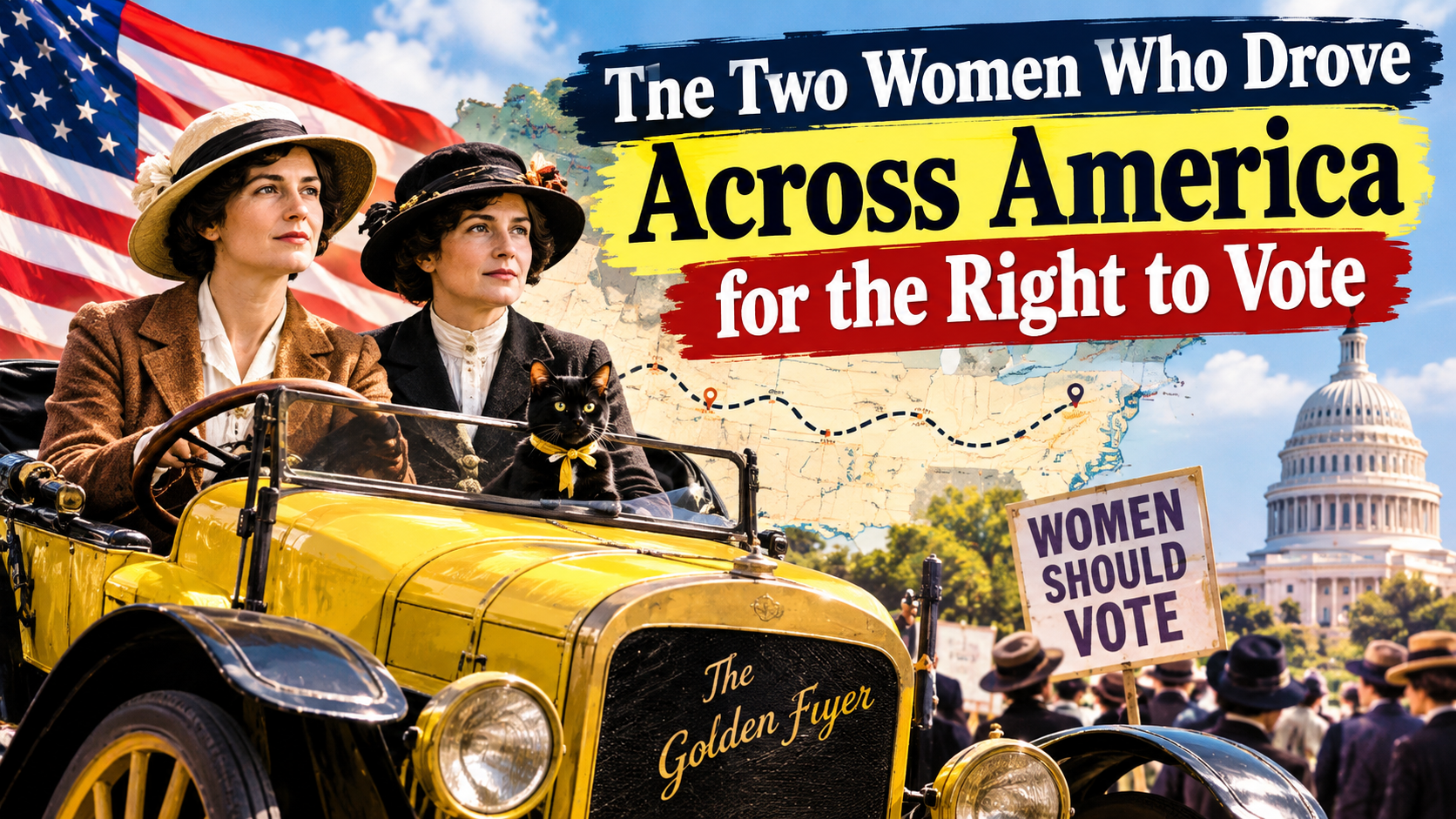
In 1916, two determined women, Nell Richardson and Alice Burke, began an extraordinary journey across the United States. Their goal was to spread awareness about women’s suffrage and encourage more Americans to support a woman’s right to vote.
Their journey would take them thousands of miles through a country where long-distance automobile travel was still a difficult undertaking.
They were not simply going on a road trip. They were carrying a message of equality from one community to another.
A Country Still Debating Women’s Right to Vote
In 1916, American women did not yet have a nationwide constitutional guarantee of the right to vote.
The women’s suffrage movement had been fighting for political equality for generations. Activists believed that women should have a voice in choosing the leaders and policies that shaped their lives.
However, opposition remained strong.
Some people believed politics was a man’s responsibility. Others feared that expanding women’s political rights would change traditional family and social arrangements.
Despite these objections, suffragists continued their campaign.
They understood that winning voting rights required more than convincing lawmakers. They also needed to reach ordinary people, build public support, and make women’s political equality a national issue.
Nell Richardson and Alice Burke chose an unusual way to help accomplish that goal.
Two Women and One Remarkable Automobile
On April 6, 1916, Richardson and Burke departed from New York City in a small automobile known as the Golden Flyer.
The car was yellow and had only two seats. At a time when automobile travel could be uncomfortable and unreliable, their decision to cross the country by road was an ambitious undertaking.
The journey was associated with the National American Woman Suffrage Association, which supported efforts to advance women’s voting rights.
Their mission was straightforward: travel across the country, speak to people in different communities, and encourage support for women’s suffrage.
The women were not traveling in modern cars equipped with navigation systems, dependable highways, and roadside assistance.
Roads were often unpaved or covered with gravel. Mechanical problems could interrupt a journey, and long-distance driving demanded patience, practical skills, and determination.
Yet Richardson and Burke were ready to face these challenges.
Their small automobile became a moving symbol of a much larger movement.
Historical source: The Library of Congress documents their departure and identifies the Golden Flyer in its 1916 photograph of the two suffragists.
Carrying the Message from Town to Town
During their journey, Richardson and Burke visited communities across the United States.
They stopped in cities and smaller towns, spoke about women’s voting rights, and encouraged people to support the suffrage movement.
Their travels included destinations such as New Orleans, Los Angeles, San Francisco, Seattle, Minneapolis, Chicago, and Detroit.
The journey covered approximately 10,700 miles, according to the Smithsonian National Museum of American History.
That distance was impressive even by modern standards. In 1916, with less reliable vehicles and far less developed roads, it required considerable determination.
The women also used their journey to attract public attention to the issue of voting rights.
They spoke to local audiences and helped spread the movement’s message beyond the places where suffrage organizations were already well established.
Every stop offered another opportunity to explain why women deserved a voice in American democracy.
Their journey demonstrated that political activism did not have to remain confined to meeting halls or major cities. It could travel directly to the people.
Historical source: The Smithsonian National Museum of American History documents their five-month journey, the route, and the approximate distance covered.
A Little Passenger Named Saxon
The Golden Flyer carried more than two determined campaigners.
During their travels, Richardson and Burke also acquired a small black kitten named Saxon.
The kitten became their unofficial mascot and attracted attention along the way.
The story of Saxon adds a memorable detail to an otherwise demanding political journey. It also connects the trip to the broader history of how suffragists used creative symbols to attract public interest.
The women’s campaign was about a serious issue, but that did not prevent them from finding ways to make their message more approachable.
Their automobile, their public appearances, and even their feline companion helped make the journey distinctive.
The National Park Service has also documented the connection between the trip, Saxon, and the use of cats as symbols in the women’s suffrage movement.
Why Their Journey Mattered
Richardson and Burke’s road trip took place during an important period in the American women’s suffrage movement.
In 1916, the country was approaching a major political debate over whether women’s voting rights should receive stronger national support.
The two women used their journey to encourage public discussion and promote the cause at a time when political campaigns depended heavily on newspapers, public meetings, and direct personal contact.
Their work was part of a much larger movement involving thousands of activists.
Women had organized conventions, delivered speeches, circulated petitions, and participated in demonstrations for decades. The Golden Flyer journey was one creative example of how suffragists tried to bring their cause to a wider audience.
It would be inaccurate to say that this single road trip won women the right to vote. The achievement came through the combined efforts of generations of activists, organizers, and supporters.
Nevertheless, Richardson and Burke’s journey illustrates the determination and imagination that helped keep the movement alive.
They took their message onto the roads and brought it to communities across America.
The Road to the Nineteenth Amendment
The struggle for women’s voting rights continued after Richardson and Burke completed their journey.
On June 4, 1919, the United States Congress passed a resolution proposing the Nineteenth Amendment to the Constitution.
The amendment was ratified by the required number of states in August 1920 and formally certified that month.
It established that the right to vote could not be denied by the United States or any state on the basis of sex.
This was a major milestone in American history.
However, the amendment did not immediately guarantee equal access to voting for every woman. Many Black women and other women of color continued to face discriminatory laws, intimidation, and other barriers that restricted their ability to vote.
The broader struggle for equal voting rights therefore continued long after 1920.
Richardson and Burke’s journey belongs to the history of that wider fight: a campaign built through many different acts of courage, persistence, and public engagement.
Two Women Who Took Their Message on the Road
Today, the Golden Flyer journey offers a reminder that meaningful change can require people to leave their comfort zones and find new ways to reach others.
Nell Richardson and Alice Burke did not have the technology or conveniences available to travelers today.
They had a small automobile, a long route ahead, and a cause they believed deserved national attention.
Their journey did not single-handedly transform American democracy. But it helped carry the message of women’s suffrage to communities across the country during a critical period in the movement.
Their story deserves to be remembered not simply because they drove thousands of miles, but because they used that journey to support a fundamental democratic principle.
The right to vote should not depend on whether a person is a man or a woman.
In 1916, Richardson and Burke took that message onto America’s roads, one town and one conversation at a time.
Their journey remains a fascinating chapter in the long struggle for women’s political equality.
Sources
The following reliable sources were consulted to verify the historical details of this article.
Library of Congress — Historical photograph and record of Nell Richardson and Alice Burke with the Golden Flyer in April 1916.
Library of Congress: The Golden Flyer
Smithsonian National Museum of American History — Historical account of the women’s five-month cross-country journey, its purpose, and the distance traveled.
Smithsonian: Two Women, a Cat, a Car, and a Mission
National Park Service — Historical information about the journey and the role of Saxon, the suffrage cat.
National Park Service: Suffrage Cat
Library of Congress Research Guide — Timeline and historical newspaper resources documenting the Golden Flyer suffragists’ journey.
Library of Congress: Golden Flyer Suffragettes
National Archives — For additional research on the Nineteenth Amendment and the history of women’s voting rights.
National Archives: The 19th Amendment
Leave a Reply