
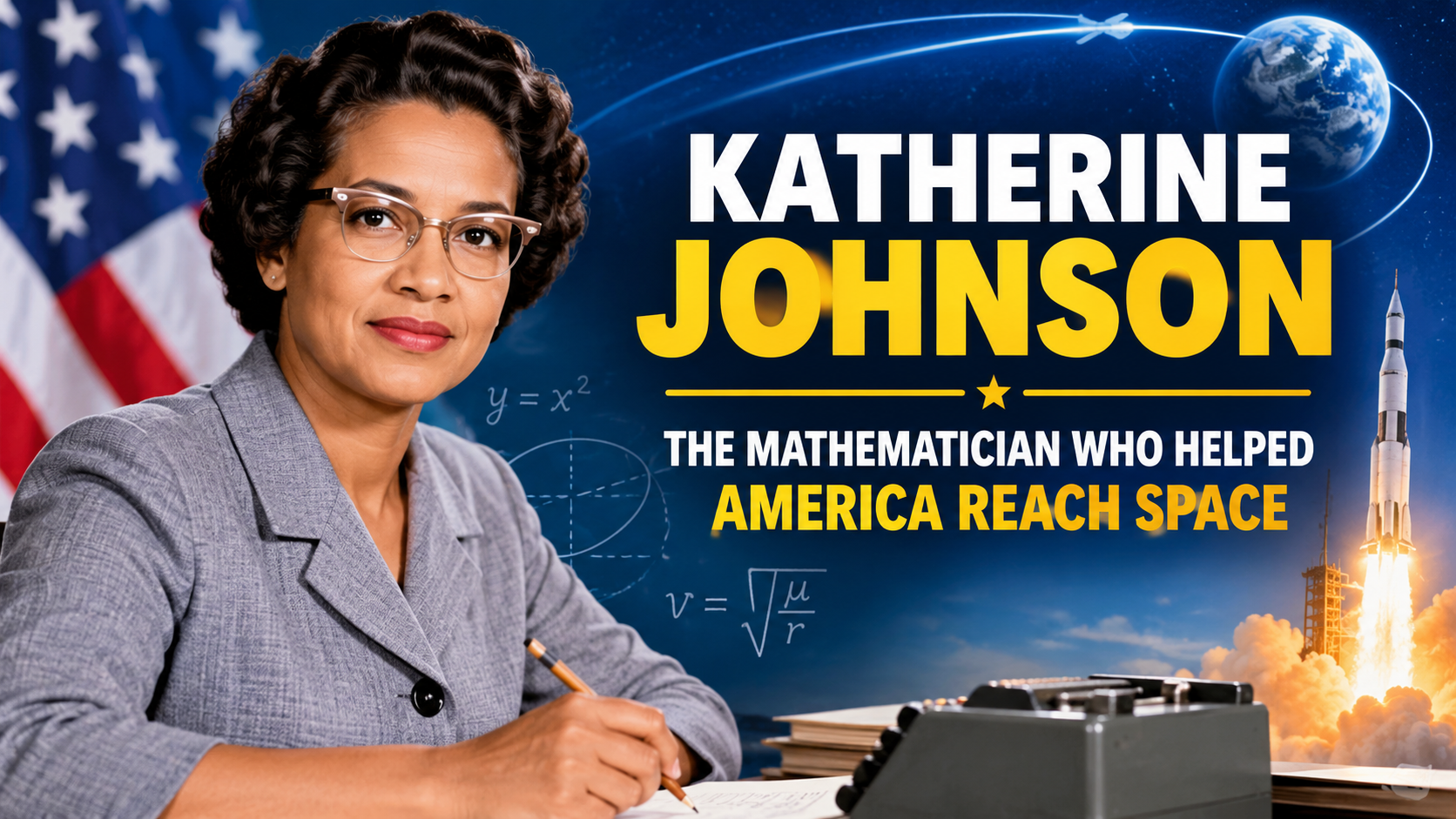
Before astronauts could travel into space, mathematicians had to calculate their spacecraft’s paths with extraordinary accuracy. One of the people who helped make America’s early space missions possible was Katherine Johnson, an African American mathematician whose work became an important part of NASA’s history.
Her journey was not only about mathematics. It was also about determination, scientific discovery, and overcoming barriers that limited opportunities for women of color.
A Young Girl Who Loved Mathematics
Katherine Coleman Johnson was born on August 26, 1918, in White Sulphur Springs, West Virginia. She showed an exceptional talent for mathematics from childhood and advanced through school quickly.
Her father, Joshua Coleman, strongly valued education. Because educational opportunities for Black children were limited by segregation, her family made significant efforts to ensure that Katherine and her siblings could continue studying.
Katherine graduated from West Virginia State College in 1937 with degrees in mathematics and French. She initially became a teacher, but her interest in mathematics would eventually lead her toward a remarkable scientific career.
According to NASA’s biography of Katherine Johnson, her strong mathematical abilities helped her progress from teaching into research that supported America’s developing space program.
Joining America’s Space program
In 1953, Katherine joined the National Advisory Committee for Aeronautics (NACA), the organization that preceded NASA. She worked at the Langley Research Center in Virginia, where African American women performed complex calculations for engineers and researchers.
These women were known as “human computers.” Before electronic computers became widely used, people carried out mathematical calculations by hand or with mechanical calculating machines.
Katherine initially worked in the West Area Computing section under Dorothy Vaughan. She later moved into assignments involving flight research and engineering.
She was curious about the problems she solved and wanted to understand the reasons behind the calculations. Her willingness to ask questions and contribute to technical discussions helped her take on increasingly important responsibilities.
The Mathematics Behind America’s First Spaceflight
The space race accelerated after the Soviet Union launched Sputnik in 1957. The United States needed scientists and engineers who could calculate spacecraft trajectories and help plan safe missions.
In 1960, Katherine Johnson and engineer Ted Skopinski coauthored a technical report explaining mathematical equations for an orbital flight in which a spacecraft’s landing position was specified. NASA records identify this as the first time a woman in her division received credit as an author of a research report.
Her work also contributed to Shepard’s Freedom 7 mission in May 1961. Shepard became the first American to travel into space, marking a major milestone in the country’s space program.
These missions required careful calculations to determine how a spacecraft would travel and where it would return to Earth.
Why John Glenn Trusted Katherine Johnson
One of the best-known moments in Katherine’s career occurred in 1962, when NASA prepared astronaut John Glenn for his orbital flight aboard Friendship 7.
Electronic computers were being used to calculate the spacecraft’s trajectory, but the technology was still relatively new. Glenn wanted additional confidence in the calculations before his mission.
According to NASA’s historical account, Glenn asked engineers to have Katherine personally check the computer’s calculations by hand.
She independently worked through the equations using a mechanical calculating machine. Her verification helped provide confidence in the mission’s flight plan.
On February 20, 1962, Glenn successfully orbited Earth, becoming the first American to do so.
The story illustrates an important lesson from the early space program: advanced technology is valuable, but careful verification and skilled people remain essential to complex scientific work.
Source: NASA — Katherine Johnson Biography.
Helping America Reach the Moon
Katherine’s contributions continued beyond the Mercury missions. She worked on calculations connected with the Apollo program, including the 1969 Apollo 11 mission that carried astronauts to the Moon.
Her work involved spacecraft trajectories and the mathematics needed to coordinate different parts of a mission. NASA’s records also describe her contributions to the Space Shuttle program and Earth-observation satellite work.
She spent 33 years working at Langley before retiring in 1986. During her career, she authored or coauthored numerous technical reports.
Although astronauts received much of the public attention, their missions depended on the expertise of many people working behind the scenes. Katherine was among the mathematicians whose calculations supported these historic achievements.
Breaking Barriers and Inspiring Generations
Katherine worked during a period when racial segregation and discrimination restricted opportunities for African American women. At Langley, Black women mathematicians were initially assigned to a segregated computing section.
Despite these barriers, Katherine continued developing her skills and contributing to important research. Her achievements also helped bring attention to other talented women, including Dorothy Vaughan and Mary Jackson.
Their stories later reached a wider audience through Margot Lee Shetterly’s book Hidden Figures and its 2016 film adaptation.
In 2015, President Barack Obama awarded Katherine Johnson the Presidential Medal of Freedom, the highest civilian honor in the United States.
Katherine died on February 24, 2020, at the age of 101. Her legacy continues to inspire students interested in mathematics, science, technology, and engineering.
A Legacy That Reached Beyond Earth
Katherine Johnson helped turn complicated mathematical problems into calculations that engineers and astronauts could use. Her work supported America’s early human spaceflights and its journey toward the Moon.
Her story reminds us that history is shaped not only by the people who stand in the spotlight but also by those whose knowledge and dedication make extraordinary achievements possible.
Katherine Johnson’s name now stands as a lasting reminder that talent, curiosity, and persistence can help change the world—even when the path forward is not easy.
Sources
NASA, Katherine G. Johnson — Official Biography
NASA, Katherine Johnson Biography — Langley Research Center
NASA Science, Katherine Johnson (1918–2020)
Leave a Reply