
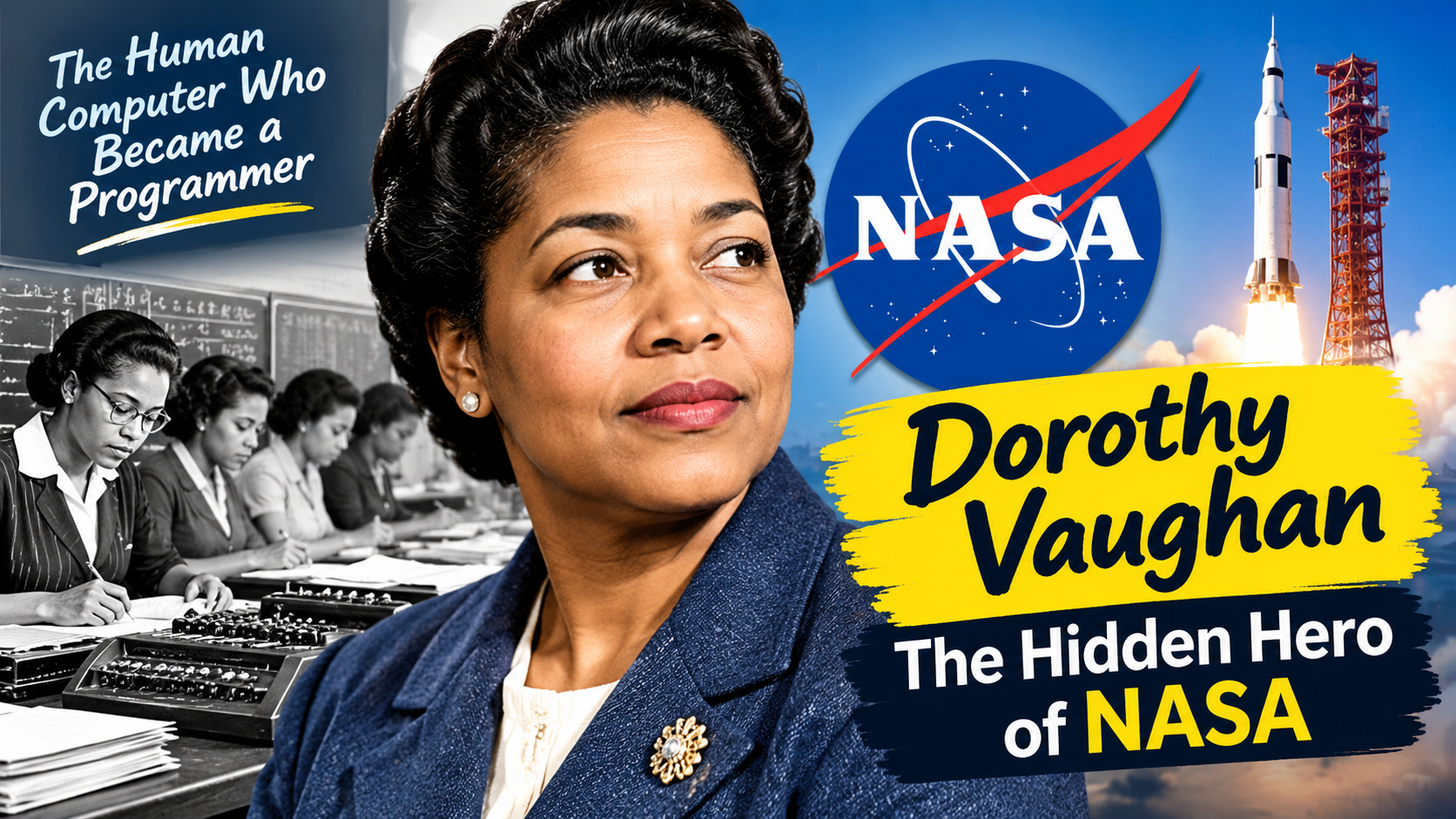
Before modern computers transformed aviation and space exploration, people performed complex mathematical calculations by hand. At NASA’s predecessor, the National Advisory Committee for Aeronautics (NACA), one remarkable mathematician helped make that work possible. Her name was Dorothy Vaughan.
Vaughan was a talented mathematician, a determined leader, and a pioneer who helped other women prepare for a new technological age. At a time when racial segregation and discrimination limited opportunities for African American women, she built a career through knowledge, perseverance, and a willingness to learn.
Her story is not only part of American aviation history. It is also a reminder that progress often depends on people whose contributions remain overlooked for years.
A Young Woman With a Talent for Mathematics
Dorothy Jean Johnson was born on September 20, 1910, in Kansas City, Missouri. Her family later moved to Morgantown, West Virginia, where she continued her education.
She demonstrated a strong ability in mathematics and received a full-tuition scholarship to Wilberforce University in Ohio, a historically Black university. She graduated in 1929 with a bachelor’s degree in mathematics at just 19 years old.
After college, Vaughan became a mathematics teacher at Robert Russa Moton High School in Farmville, Virginia. Teaching allowed her to share her knowledge, but the opportunities available to Black women in the United States were restricted by the racial discrimination of the era.
Her career would eventually take her from the classroom into one of America’s most important aeronautical research institutions.
A New Opportunity During World War II
In December 1943, during World War II, Vaughan joined the National Advisory Committee for Aeronautics at the Langley Memorial Aeronautical Laboratory in Hampton, Virginia.
The organization conducted research that helped engineers understand aircraft performance and improve aviation technology. Vaughan was hired as a mathematician, then commonly described as a human computer.
This title referred to a person who carried out mathematical calculations rather than a modern electronic machine. Human computers used tools such as slide rules and mechanical calculating machines to process research data.
Vaughan joined the West Area Computing unit, a group of African American women mathematicians. Under the segregation policies of the time, these women worked separately from their white colleagues and faced unequal treatment in the workplace.
Despite these barriers, their mathematical work was valuable to the engineers conducting aeronautical experiments. Their calculations helped researchers analyze wind-tunnel tests, flight data, and the performance of aircraft.
Vaughan’s position required accuracy, patience, and a strong understanding of mathematics. Her work helped establish her reputation as a capable professional.
Becoming a Historic Leader
In 1949, Vaughan became the head of the West Area Computing group, making her the first African American supervisor at NACA. The appointment was an important milestone in an institution where leadership opportunities for Black women were extremely limited.
She remained responsible for the group until 1958. Her duties went beyond completing mathematical assignments. She helped organize work, supported colleagues, and matched people’s skills with the needs of research teams.
Vaughan also advocated for employees who deserved promotions and better pay. Her support was not limited to the women in her own group; NASA’s historical account notes that she also spoke up for deserving white employees.
Engineers respected her judgment and sometimes requested her assistance with especially difficult calculations. Her leadership showed that successful scientific work depended not only on individual talent but also on cooperation and the recognition of other people’s abilities.
Although Vaughan achieved an important supervisory position, the segregation system continued to place limits on her and her colleagues.
Preparing for the Age of Electronic Computers
By the 1950s, electronic computing was beginning to change scientific research. Machines could perform calculations at speeds that would have been impossible for people working manually.
For the human computers at Langley, this technological shift brought both new possibilities and uncertainty. The skills that had made them valuable could change as research methods evolved.
Vaughan responded by learning new technology.
In 1958, NACA became NASA, and segregated work units were abolished. Vaughan joined the new Analysis and Computation Division, where she worked in an increasingly integrated environment focused on electronic computing.
She became an expert in FORTRAN, a programming language widely used for scientific and engineering calculations. She also helped other women adapt to the changing workplace and develop programming skills.
Her transition from manual calculations to computer programming demonstrated an important lesson: learning new skills can help people remain valuable even when technology changes the nature of their work.
Vaughan also contributed to the Scout Launch Vehicle Program, which supported America’s efforts to develop reliable launch vehicles for placing satellites into orbit.
Her career therefore extended beyond the era of hand calculations and into the early development of modern aerospace computing.
A Legacy That Reached Beyond Her Own Career
Vaughan retired from NASA in 1971 after a career that began during World War II and continued through the early Space Age.
She did not receive another management position after the changes of 1958, but her influence extended through the women she supported and the work she helped advance. Her colleagues included mathematicians and engineers who went on to make important contributions of their own.
Vaughan died on November 10, 2008, in Hampton, Virginia, at the age of 98.
Her story later reached a wider audience through Hidden Figures, the book by Margot Lee Shetterly and the 2016 film adaptation, which brought attention to Vaughan, Katherine Johnson, Mary Jackson, and other African American women who worked at NACA and NASA.
Their experiences reveal a part of American scientific history that deserves recognition: major technological achievements were supported not only by astronauts and famous engineers, but also by mathematicians whose calculations and programming helped make research possible.
Why Dorothy Vaughan’s Story Still Matters
Dorothy Vaughan’s achievements were about more than mathematics. She advanced into leadership despite discrimination, adapted to changing technology, and helped colleagues prepare for new opportunities.
Her career also challenges the idea that progress belongs only to the people whose names appear most often in history books. Behind every major scientific breakthrough are many people whose careful work makes success possible.
From a mathematics classroom to the early world of aerospace computing, Vaughan built a lasting legacy through determination, technical skill, and support for others.
Her life reminds us that the future belongs not simply to those who master today’s tools, but also to those who continue learning and help others move forward.
Sources and Further Reading
NASA — Dorothy Vaughan: Official biography covering her education, career at NACA and NASA, leadership, and programming work.
https://www.nasa.gov/people/dorothy-vaughan/
NASA — Dorothy J. Vaughan: Historical account of her work at Langley, the West Area Computing unit, FORTRAN programming, and the Scout Launch Vehicle Program.
https://www.nasa.gov/centers-and-facilities/langley/dorothy-j-vaughan/
Smithsonian American Women’s History Museum — Human Computer Project: Background on human computers, Vaughan’s transition to programming, and the women who worked in aerospace research.
https://womenshistory.si.edu/human-computer-project
Leave a Reply