
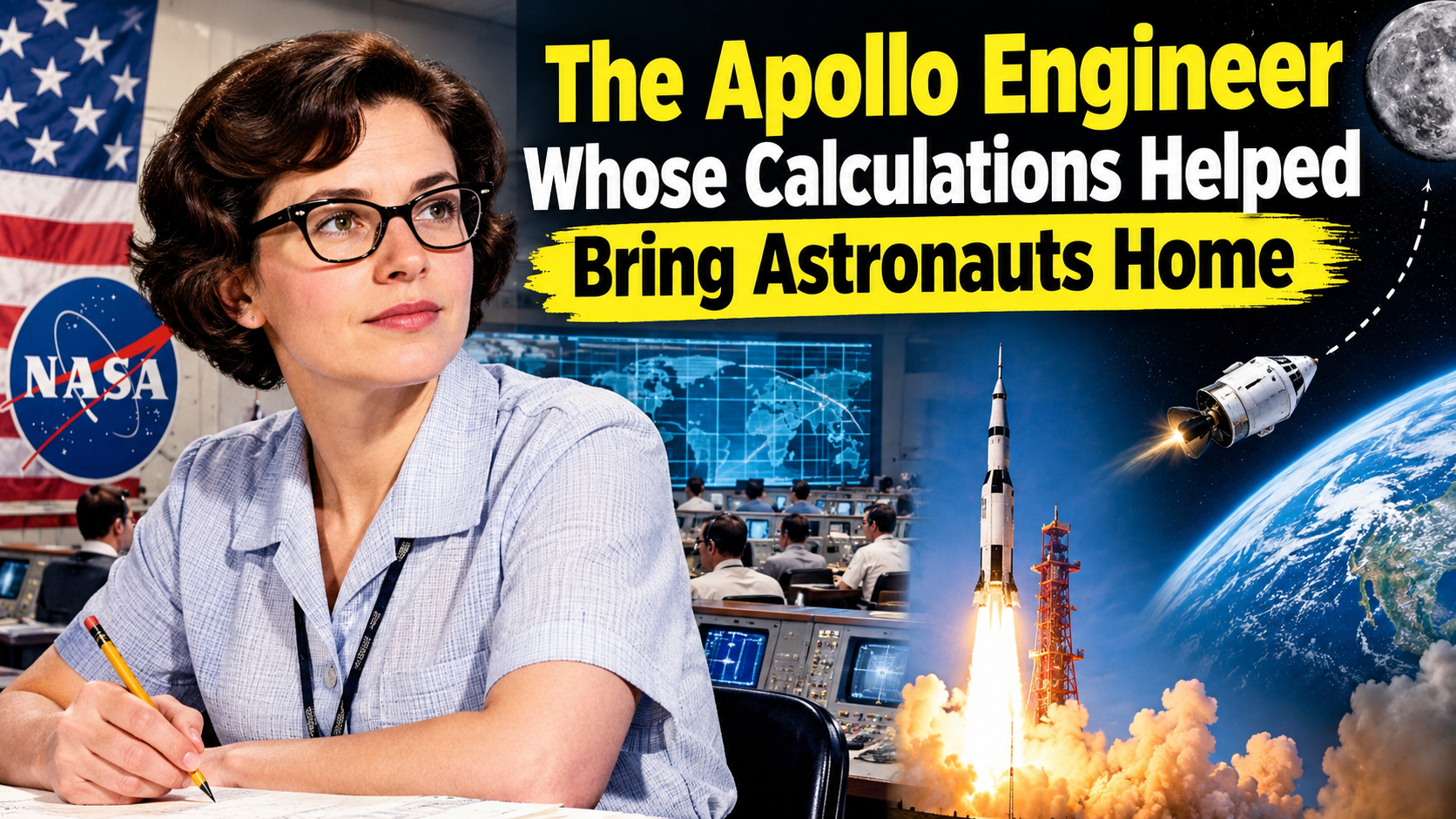
When people remember America’s historic journeys to the Moon, they often think of the brave astronauts who traveled through space. However, behind every successful mission were mathematicians, engineers, and programmers whose work helped spacecraft navigate safely. One of these talented professionals was Frances “Poppy” Northcutt, a mathematician who contributed to NASA’s Apollo program.
Her work on spacecraft return trajectories helped support America’s early crewed lunar missions. Her story also broke barriers for women working in aerospace during a period when technical engineering roles were largely dominated by men.
A Mathematician Joins the Space Race
Frances Northcutt studied mathematics at the University of Texas at Austin. During the 1960s, the United States was working to achieve President John F. Kennedy’s goal of landing astronauts on the Moon and returning them safely to Earth.
Northcutt joined TRW, an aerospace contractor supporting NASA’s Apollo program. She worked on computer programs used to calculate spacecraft trajectories, including routes that could bring astronauts back from the Moon.
These calculations required an understanding of spacecraft movement, gravity, speed, and timing. Even a small error could create serious problems during a space mission.
Northcutt’s work was part of a much larger team effort. Mathematicians, engineers, programmers, and flight controllers all contributed different skills to help NASA plan and operate its missions.
Her experience demonstrated that mathematics was not simply an academic subject. In the space program, mathematical calculations could help determine whether astronauts returned home safely.
Source: Smithsonian National Air and Space Museum.
The Challenge of Returning From the Moon
Sending a spacecraft toward the Moon was only one part of the challenge. NASA also needed reliable plans for bringing astronauts back to Earth.
A spacecraft traveling through space follows a path influenced by gravity, its speed, and the direction of its movement. Engineers must calculate the correct trajectory and determine when particular maneuvers should take place.
Northcutt contributed to the computer programs used to calculate return trajectories for Apollo missions. These programs helped engineers analyze possible flight paths and prepare for the complicated journey home.
The work required accuracy, patience, and cooperation. Computer programs had to be developed and checked carefully before their results could support mission operations.
Northcutt’s contribution became especially significant as NASA prepared for missions that would carry astronauts around the Moon and eventually onto its surface.
Apollo 8 and a Historic Achievement
In December 1968, Apollo 8 became the first crewed spacecraft to travel to the Moon, orbit it, and return to Earth.
Astronauts Frank Borman, James Lovell, and William Anders made history by traveling farther from Earth than humans had ever traveled before.
Their journey required extensive preparation, including calculations for the return trip. After completing their lunar orbit, the astronauts had to follow a carefully planned trajectory back toward Earth.
Northcutt’s work on Apollo return-trajectory calculations contributed to the wider technical effort behind these missions.
She also became the first woman to work in a technical engineering role on the floor of NASA’s Mission Control Center. Her presence represented an important step for women seeking opportunities in aerospace engineering.
Apollo 8 proved that astronauts could travel to the Moon and return safely. It also prepared NASA for the next stage of lunar exploration.
Source: Smithsonian National Air and Space Museum.
Apollo 13: A Mission Turns Into an Emergency
Northcutt’s Apollo-era work is particularly relevant to understanding the importance of spacecraft return planning.
Apollo 13 launched on April 11, 1970, carrying astronauts James Lovell, John Swigert, and Fred Haise.
On April 13, an oxygen tank in the spacecraft’s service module ruptured. The accident forced NASA to abandon the planned lunar landing and concentrate on returning the astronauts safely.
The damaged spacecraft faced serious challenges. Engineers and flight controllers on Earth had to evaluate the situation, conserve essential resources, and determine how the crew could complete its journey home.
Northcutt was among the specialists associated with the Apollo return-trajectory program. The emergency highlighted the importance of the calculations and technical preparations that supported spacecraft navigation.
However, the astronauts’ safe return was not the achievement of one individual. It depended on the combined efforts of the crew, engineers, mathematicians, flight controllers, and other NASA personnel.
On April 17, 1970, Apollo 13 splashed down safely in the Pacific Ocean. All three astronauts survived.
Although the mission did not achieve its original lunar-landing objective, its successful recovery demonstrated the value of preparation, teamwork, and technical problem-solving.
Source: NASA, “Apollo 13: A Successful Failure.”
Breaking Barriers for Women in Aerospace
Northcutt’s career was significant for another reason: she worked in a field where women faced considerable professional barriers.
During the 1960s, women were underrepresented in engineering and aerospace leadership. Her technical position in Mission Control challenged expectations about the roles women could perform in the American space program.
Her achievements helped make women’s contributions to space exploration more visible.
Northcutt’s story also reminds us that the history of spaceflight includes more than astronauts and famous launches. It includes people whose mathematical knowledge, programming skills, and engineering expertise helped make those missions possible.
A Legacy Beyond the Moon
Frances “Poppy” Northcutt’s work remains an important part of the history of America’s Apollo program. Her contribution to spacecraft return calculations illustrates how mathematical thinking can support extraordinary achievements.
The Apollo missions required thousands of people working together toward a shared goal. While astronauts traveled into space, specialists on Earth helped solve the technical problems that made their journeys possible.
Northcutt’s story is a reminder that exploration depends on both courage and careful planning. Reaching the Moon was a remarkable achievement, but bringing astronauts safely home was equally important.
Her career also helped challenge barriers for women in technical professions, leaving an inspiring example for future generations interested in mathematics, engineering, and space exploration.
Sources and Further Reading
Smithsonian National Air and Space Museum: https://www.smithsonianmag.com/blogs/air-space-museum/2019/12/18/calculating-trajectories-and-breaking-boundaries-during-apollo/
University of Texas at Austin: https://cns.utexas.edu/news/features/looking-back-apollo-11-seeing-ut-reflected-in-nasa-history
NASA — Apollo 13: A Successful Failure: https://www.nasa.gov/news-release/nasa-commemorates-50th-anniversary-of-apollo-13-a-successful-failure/
Leave a Reply