
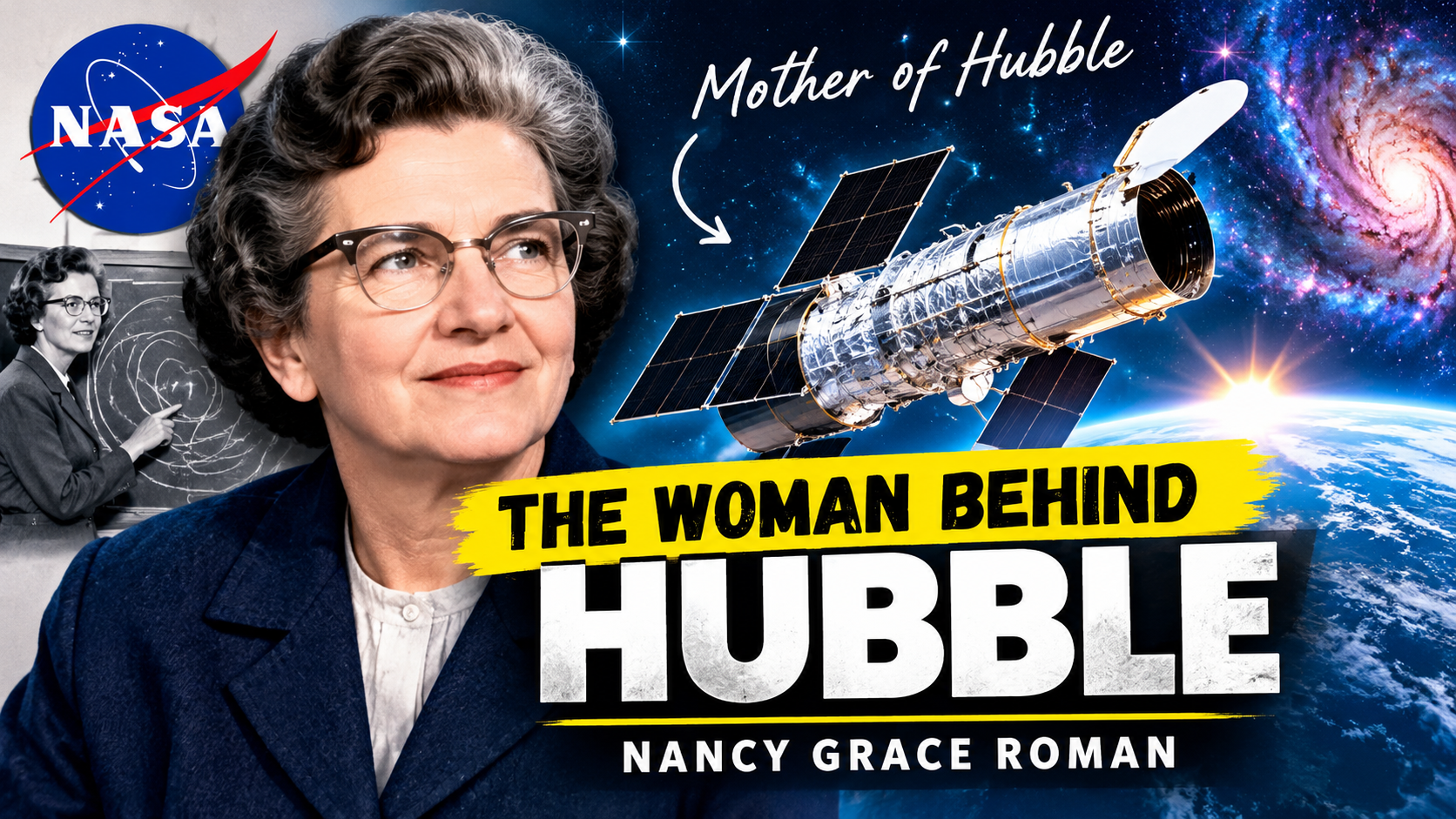
When people think about the Hubble Space Telescope, they often imagine breathtaking photographs of distant galaxies, glowing nebulae, and stars scattered across the universe. But behind this extraordinary observatory was a long journey involving scientists, engineers, and determined individuals who believed that humanity could explore space in entirely new ways.
One of the most important figures in that journey was Nancy Grace Roman, an American astronomer whose scientific leadership helped make the Hubble Space Telescope possible. Although she did not personally construct the telescope, her work at NASA helped turn an ambitious scientific vision into reality.
Today, she is widely known as the “Mother of Hubble.”
A Childhood Fascinated by the Stars
Nancy Grace Roman was born on May 16, 1925, in Nashville, Tennessee. Her fascination with astronomy began when she was young.
As a child, she became interested in the night sky and wanted to understand the stars and the universe beyond Earth. Her curiosity eventually developed into a serious scientific ambition.
At a time when women faced considerable barriers in scientific careers, Roman continued pursuing her interest in astronomy.
She attended college and later earned a doctorate in astronomy from the University of Chicago in 1949. Her education prepared her for a career that would eventually influence the future of American space science.
Roman’s journey demonstrated that determination and scientific curiosity could help challenge the limitations women encountered in professional research.
Joining NASA at a Historic Moment
In 1959, Roman joined the National Aeronautics and Space Administration, better known as NASA.
The United States was entering a new era of space exploration. Scientists were increasingly interested in placing scientific instruments above Earth’s atmosphere to obtain observations that were difficult to achieve from the ground.
Earth’s atmosphere can distort incoming light and block certain wavelengths of radiation. A telescope operating in space could avoid many of these limitations and provide astronomers with clearer observations of distant objects.
Roman became NASA’s first chief of astronomy. In this position, she helped establish priorities for space-based astronomical research and encouraged scientists to develop ambitious new projects.
Her responsibilities included communicating with researchers, organizing scientific goals, and explaining to decision-makers why space astronomy deserved long-term investment.
One project became especially important: the development of a powerful space telescope that could transform humanity’s understanding of the universe.
Turning an Ambitious Idea Into Reality
The idea of a telescope in space existed before Roman joined NASA. In 1946, astronomer Lyman Spitzer published a paper explaining the scientific advantages of placing a large telescope above Earth’s atmosphere.
However, transforming that concept into an actual mission required years of planning, funding, engineering, and scientific cooperation.
Roman played an important role in advancing the project. She helped connect astronomers with engineers and worked to build support for a space observatory that could answer fundamental questions about the cosmos.
Scientists needed to define what they wanted the telescope to discover. Engineers had to determine how to design an instrument that could survive launch, operate in orbit, and collect accurate observations.
Government officials also needed to be convinced that the project justified its substantial cost.
Roman helped bridge these different groups. She advocated for the scientific value of the telescope and supported the development of the research programs needed to make the mission successful.
Her contribution was not about building every component herself. Instead, she helped create the scientific vision and institutional support that allowed the project to progress.
Why Scientists Wanted a Telescope in Space
Observing the universe from Earth has important limitations.
The atmosphere constantly moves and changes, which can blur the light coming from distant astronomical objects. It also absorbs certain forms of radiation that scientists would like to study.
A space telescope could overcome many of these difficulties.
Astronomers hoped that such an observatory would help them investigate distant galaxies, examine the formation and evolution of stars, and improve their understanding of the universe.
These questions were fundamental to astronomy. By observing objects far beyond our solar system, scientists could investigate how the universe developed and how its structures changed over time.
Roman understood that a successful space telescope could benefit generations of researchers.
She continued advocating for the project and helped build the scientific support needed to move it forward.
Her story illustrates an important truth about scientific progress: discoveries often begin with years of planning and persuasion before an instrument ever reaches space.
From the Drawing Board to Hubble
The proposed observatory became known as the Large Space Telescope. It was eventually named the Hubble Space Telescope in honor of American astronomer Edwin Hubble.
Edwin Hubble’s research helped establish that galaxies exist beyond the Milky Way and provided important evidence that the universe is expanding.
The telescope’s development required contributions from numerous scientists, engineers, technicians, research institutions, and contractors.
Roman was one of the important figures who helped establish the project’s scientific direction and secure support for its development.
The work took decades. Technical challenges, funding decisions, and other events affected the project’s schedule.
Eventually, the Hubble Space Telescope was ready for launch.
On April 24, 1990, the Space Shuttle Discovery lifted off carrying Hubble into orbit. Astronauts deployed the telescope on April 25.
A scientific vision that had required years of discussion, planning, and engineering had finally become a working space observatory.
A Difficult Beginning and an Extraordinary Recovery
Hubble’s early observations revealed an unexpected problem.
Scientists discovered that the telescope’s primary mirror had a flaw that prevented it from producing the sharp images originally expected. The discovery was a serious disappointment because the telescope had been designed to provide exceptionally detailed views of the universe.
However, engineers and scientists worked to find a solution.
In December 1993, astronauts aboard the Space Shuttle Endeavour carried out a servicing mission. They installed corrective optics and upgraded equipment to compensate for the mirror’s flaw.
The mission succeeded, allowing Hubble to produce the sharp images astronomers had hoped to obtain.
Subsequent servicing missions improved the observatory further, extending its scientific capabilities.
Hubble eventually delivered remarkable views of galaxies, nebulae, star-forming regions, and other distant objects. Its observations also contributed to research into the expansion of the universe and many other important astronomical questions.
The observatory became one of the most influential scientific instruments of its time.
Its success reflected the efforts of thousands of people, including those who had worked to make the original mission possible.
Nancy Grace Roman’s Lasting Legacy
Roman retired from NASA in 1979, but her influence on astronomy continued.
She died on December 25, 2018, at the age of 93.
Her legacy extends beyond the Hubble Space Telescope itself. She helped establish space-based astronomy as an important part of NASA’s scientific mission and demonstrated the value of long-term planning, collaboration, and persistence.
In recognition of her pioneering contributions, NASA named a future space observatory the Nancy Grace Roman Space Telescope.
The mission was designed to investigate major questions about the universe, including dark energy and the discovery and study of planets beyond our solar system.
Naming the observatory after Roman recognizes her influence on space astronomy and her role in helping establish the foundations for future scientific missions.
Her story also highlights the contributions women have made to American science, even when they worked in fields where opportunities were often limited.
The Woman Behind a New View of the Universe
Nancy Grace Roman did not build the Hubble Space Telescope alone. No single person could have accomplished such a complex project.
Its development required the combined knowledge, creativity, and dedication of scientists and engineers working over many years.
Yet Roman played a significant role in helping turn the idea of a space telescope into a practical scientific goal.
Her determination helped make it possible for astronomers to explore the universe with an observatory above Earth’s atmosphere.
Today, Hubble’s images continue to inspire people around the world. They reveal cosmic structures that are difficult to imagine and encourage new generations to ask questions about the universe.
Behind those discoveries is a history of scientific ambition and persistence.
Nancy Grace Roman helped America look beyond Earth and imagine what humanity might discover among the stars. Her story reminds us that changing history does not always mean being the person who launches a rocket or appears in a photograph.
Sometimes, it means believing in an idea, bringing people together, and working patiently until that idea becomes reality.
Nancy Grace Roman helped open a new window onto the universe, leaving a legacy that continues to inspire astronomy and space exploration.
Sources and Further Reading
NASA — Nancy Grace Roman: The Mother of Hubble
https://science.nasa.gov/missions/hubble/nancy-grace-roman-the-mother-of-hubble/
NASA — The History of Hubble
https://science.nasa.gov/mission/hubble/overview/the-history-of-hubble/
NASA — Nancy Grace Roman Space Telescope
https://science.nasa.gov/mission/roman-space-telescope/
These sources provide historical and scientific background on Nancy Grace Roman, the Hubble Space Telescope, and NASA’s continuing work in space astronomy.
Leave a Reply