
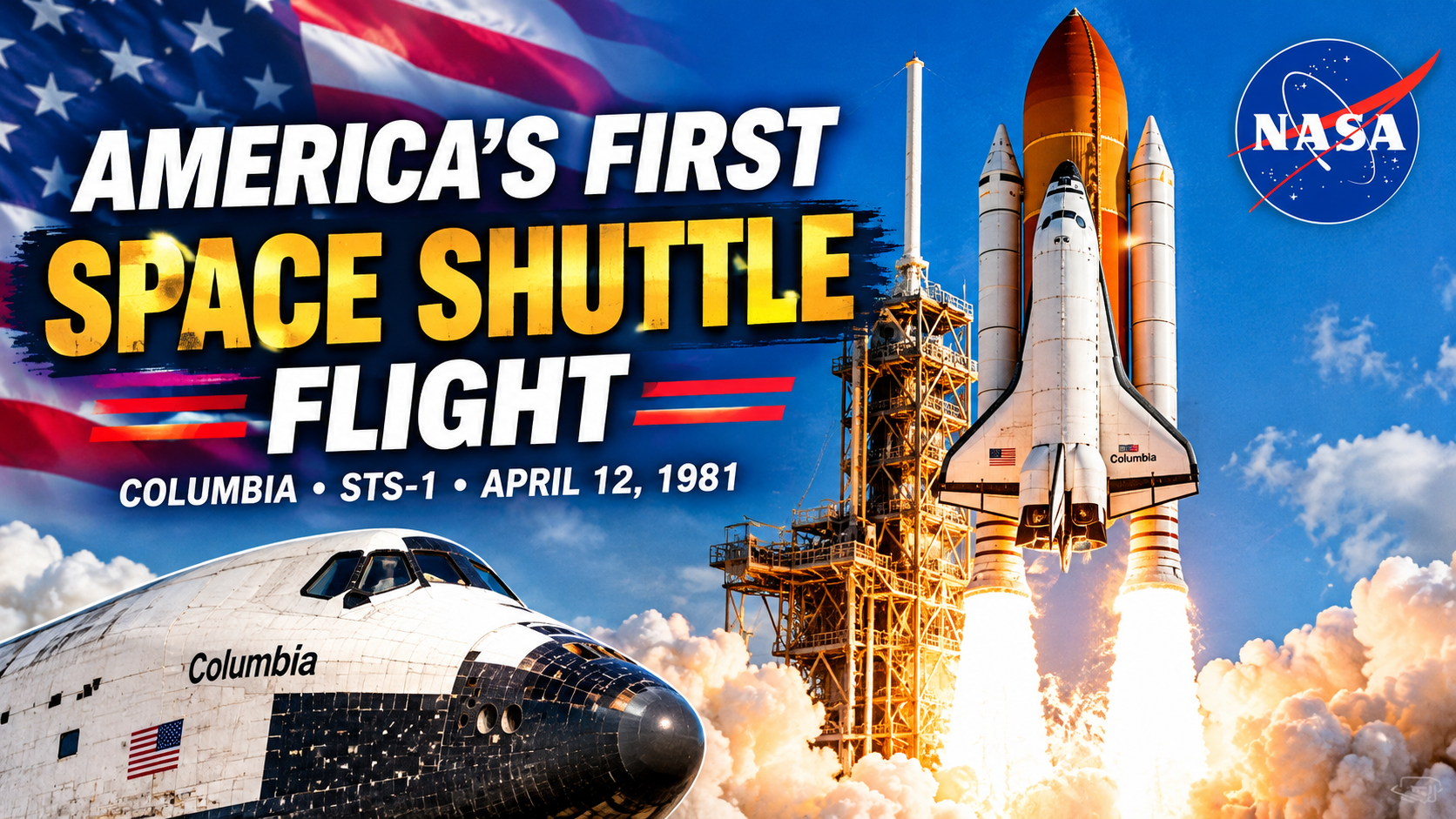
On the morning of April 12, 1981, a new chapter in American space exploration began. A spacecraft unlike any that had carried American astronauts into orbit before stood ready at Kennedy Space Center in Florida. Its name was Columbia, and its mission was to test a revolutionary idea: a spacecraft that could travel into orbit and return to Earth to fly again.
The mission, known as STS-1, was the first orbital flight of NASA’s Space Shuttle program. It represented years of engineering, planning, testing, and determination. More importantly, it marked the beginning of a new approach to human spaceflight.
Why America Needed a New Spacecraft
During the early years of American space exploration, astronauts traveled in relatively small capsules launched by rockets. These spacecraft were designed to return to Earth, but the capsules themselves were not reusable in the same way an airplane could be used for repeated flights.
NASA wanted to develop a different system. The goal was a spacecraft that could carry astronauts and equipment into orbit, return through the atmosphere, and land on a runway.
In January 1972, President Richard Nixon announced that the United States would develop the Space Shuttle program. NASA hoped the new system would eventually make access to space more flexible and support a wide range of missions.
The design was ambitious. The shuttle combined a winged orbiter, a large external fuel tank, and two solid rocket boosters. Each component had a different role in getting the spacecraft into orbit.
Creating a vehicle capable of surviving launch, operating in the harsh environment of space, and returning safely to Earth was a major engineering challenge.
Preparing for the First Flight
The development of the Space Shuttle took years. Engineers and technicians had to test its engines, computers, thermal protection system, and many other components before NASA could risk sending astronauts aboard.
The shuttle’s heat-resistant tiles were particularly important. During its return to Earth, the spacecraft would encounter intense heating as it passed through the atmosphere. Its thermal protection system had to shield the vehicle from those temperatures.
NASA also needed confidence that the shuttle’s flight-control systems could manage the journey from launch to landing.
The first orbital mission would be different from many earlier spaceflights because the shuttle was a complex, reusable vehicle. NASA had to evaluate how its major systems performed together, not simply whether a rocket could reach space.
Space Shuttle Columbia became the vehicle selected for this historic test.
A Launch Delayed by a Computer Problem
The first launch attempt was scheduled for April 10, 1981. However, a computer timing problem prevented the countdown from proceeding to liftoff.
NASA’s engineers and flight controllers investigated the issue and worked to correct it. Although the delay was frustrating, it demonstrated why extensive testing and careful troubleshooting were essential to the mission.
The team prepared for another attempt two days later.
On April 12, 1981, Columbia stood ready once again at Kennedy Space Center. The spacecraft carried two astronauts: Commander John W. Young and pilot Robert L. Crippen.
Young was an experienced astronaut who had already flown several space missions, including a journey to the Moon. Crippen, a former Navy test pilot, was making his first spaceflight.
Their experience was important, but neither astronaut could eliminate the risks associated with testing an entirely new spacecraft.
April 12, 1981: Columbia Takes Flight
At 7:00 a.m. Eastern Standard Time, Columbia lifted off from Launch Pad 39A.
Its main engines ignited first, followed by the two solid rocket boosters. The powerful combination propelled the shuttle away from the launch pad and toward orbit.
For NASA, the moment was the result of years of work by engineers, technicians, astronauts, computer specialists, and ground crews.
Columbia successfully reached orbit, beginning the first orbital test flight of the Space Shuttle program.
The launch also took place exactly 20 years after Soviet cosmonaut Yuri Gagarin became the first human to travel into space on April 12, 1961.
The date connected two important milestones in human spaceflight history.
What Happened During the Mission?
The STS-1 mission was designed primarily to demonstrate that the shuttle could launch safely, operate in orbit, and return to Earth.
During the flight, Young and Crippen checked spacecraft systems and carried out planned tests. They evaluated the vehicle’s performance, including its ability to maneuver in space and control its orientation.
The crew also operated the payload bay doors, an important test because future shuttle missions would carry satellites, scientific equipment, and other payloads inside the large bay.
Columbia completed 36 orbits of Earth during the mission.
The flight was not simply a demonstration of reaching space. NASA needed evidence that the spacecraft could complete the entire journey, including its return through the atmosphere and landing.
The results would help engineers identify problems and improve the shuttle before later missions.
The Return to Earth
After approximately two days in space, Columbia began its return journey.
On April 14, 1981, the spacecraft landed at Edwards Air Force Base in California. Its wheels touched the runway after a mission lasting approximately 54 hours.
The landing was a major achievement. Unlike traditional capsules that descended under parachutes, the shuttle returned as a winged vehicle and landed on a runway.
NASA had demonstrated the essential concept behind the program: a crewed spacecraft could launch into orbit, perform its mission, and return to Earth for inspection and preparation for another flight.
The mission was successful, although the post-flight inspection revealed damage to some of the shuttle’s thermal protection tiles. Engineers examined these problems and made changes to improve the vehicle and its launch environment.
The first flight therefore provided both a major achievement and valuable lessons for future missions.
A Beginning That Changed Space Exploration
Columbia’s first flight opened the way for additional Space Shuttle missions. Later flights deployed satellites, conducted scientific research, helped repair the Hubble Space Telescope, and supported the construction of the International Space Station.
The shuttle program operated for 30 years, from 1981 until its final mission in 2011.
However, the program also faced serious challenges. The Challenger accident in 1986 and the Columbia accident in 2003 resulted in the loss of astronauts and led to major investigations and changes in NASA’s safety practices.
These tragedies remain an important part of the shuttle’s history and remind us that space exploration involves significant risks.
The first flight of Columbia did not prove that every future mission would be safe. It demonstrated that the shuttle’s basic design could work and provided engineers with information needed to develop the program further.
Remembering the First Flight
The story of STS-1 is about more than a spacecraft leaving the launch pad. It is a story of scientific ambition, engineering challenges, teamwork, and the willingness to test new ideas.
John Young and Robert Crippen helped demonstrate that a winged spacecraft could travel into orbit and return to a runway. Behind their mission stood thousands of people whose work made the flight possible.
On April 12, 1981, Columbia began a new era in American human spaceflight. Its first journey became the foundation for three decades of shuttle missions and an important chapter in the history of space exploration.
The achievement also left a lasting lesson: great technological advances are rarely the work of one person. They emerge from years of collaboration, careful testing, and the determination to solve difficult problems.
Sources and Further Reading
NASA — STS-1: NASA’s First Space Shuttle Mission
https://www.nasa.gov/mission/sts-1/
NASA — 40 Years Ago: Columbia Takes Flight!
https://www.nasa.gov/history/40-years-ago-columbia-takes-flight/
NASA History — The Flight of STS-1
https://www.nasa.gov/history/sts1/
NASA — Space Shuttle History Resources
https://www.nasa.gov/history/space-shuttle-history-resources
Leave a Reply