
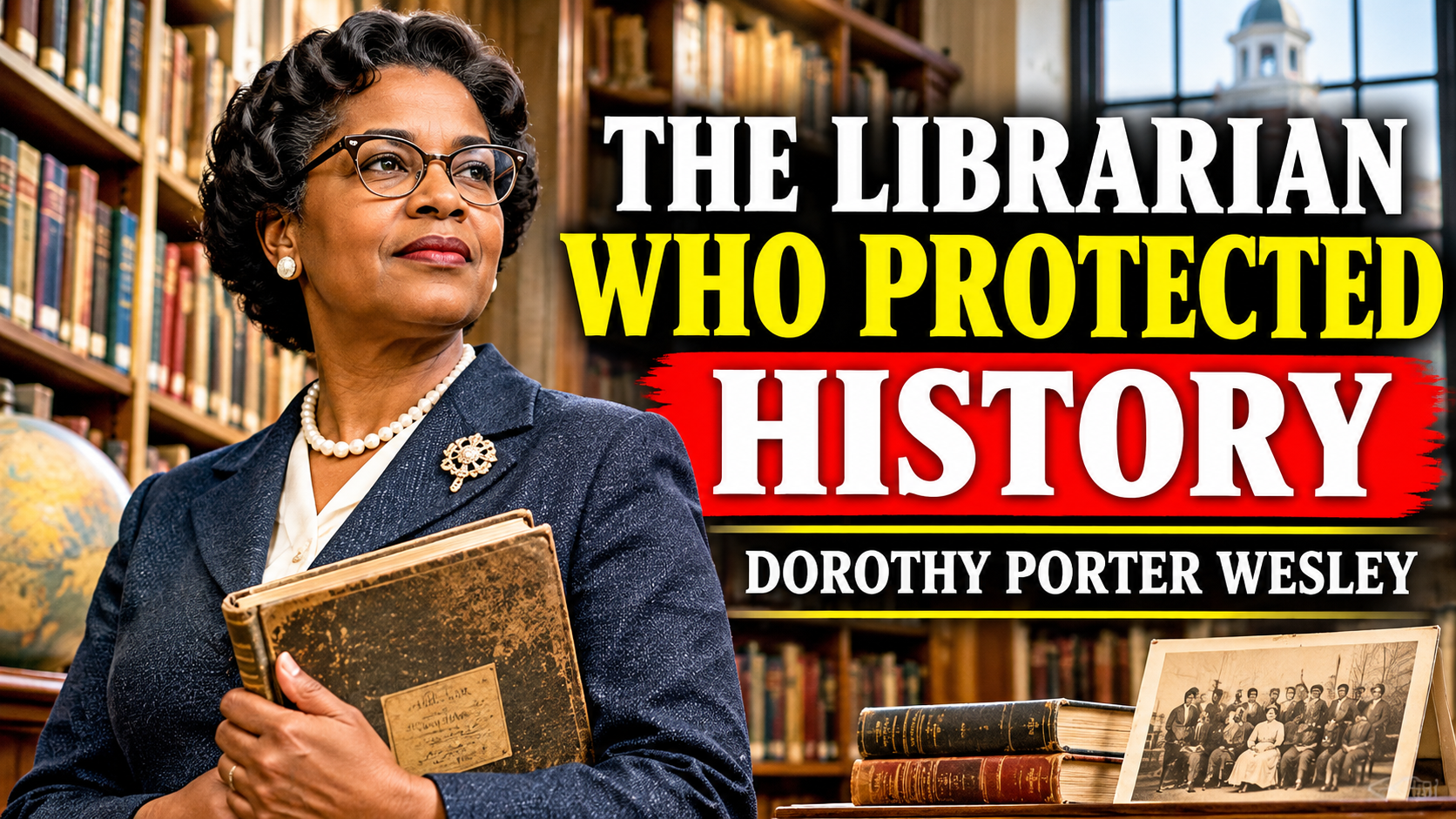
How Dorothy Porter Wesley Preserved the Stories of African American History
History is often remembered through the names of presidents, generals, and famous leaders. Yet some of the people who protect history never become widely known themselves. They work quietly in libraries, collecting forgotten documents, preserving old books, and making sure that the stories of ordinary people are not lost.
One such person was Dorothy Porter Wesley, an American librarian whose dedication helped preserve the history and culture of African Americans. Through decades of determined work, she transformed a small collection of books into one of the most important research centers dedicated to the history of people of African descent.
Her story is a reminder that protecting history is not always about discovering something new. Sometimes, it is about making sure that something important is never forgotten.
A Young Woman Who Found Her
Purpose in Books
Dorothy Louise Burnett was born on May 25, 1905, in Warrenton, Virginia. She grew up in Montclair, New Jersey, in a family that valued education.
As a young woman, Dorothy initially considered becoming a teacher. However, her experience working in a school library gradually introduced her to another profession.
Books fascinated her, but she became interested in more than simply reading them. She began to understand how libraries could organize knowledge and make it available to people who wanted to learn.
Dorothy attended Howard University in Washington, D.C., where she earned her bachelor’s degree in 1928.
After graduation, she continued working at Howard’s library. She also pursued professional training in library science at Columbia University in New York.
In 1932, she earned a master’s degree in library science, becoming one of the pioneering Black women in the field.
At a time when racial discrimination restricted educational and professional opportunities, her achievements demonstrated the importance of determination and education.
But the most significant chapter of her career was only beginning.
The Forgotten Collection at Howard University
In 1930, Dorothy was given an important responsibility at Howard University.
She was asked to organize and develop a collection devoted to African American life and history.
The foundation of this collection included books and historical materials donated by Jesse E. Moorland, an educator and collector who believed that African American history deserved greater recognition.
The collection contained valuable material, but it had not yet become the organized research resource that scholars needed.
Many historical documents, books, and publications related to African Americans were difficult to locate. Their contributions to American society were frequently overlooked in traditional historical accounts.
Dorothy recognized that preserving these materials was essential.
She began organizing the collection, identifying important works, and searching for additional materials that could expand its historical value.
The collection eventually developed into the Moorland Foundation, which later became the Moorland-Spingarn Research Center at Howard University.
This institution would become a major resource for researchers studying African American history and culture.
Searching for Stories That Had Been Forgotten
Dorothy understood that history could disappear when the documents supporting it were neglected.
A book left in an attic, a letter stored in a basement, or a pamphlet discarded by a library might contain information that future generations would need.
She therefore searched far beyond the shelves of Howard University.
She visited bookstores, contacted collectors, explored private collections, and searched for historical publications that might otherwise remain inaccessible.
Her work required patience and persistence.
Some materials were rare. Others were difficult to identify. Many had been produced by individuals whose contributions had received little attention from mainstream historians.
Dorothy believed these materials deserved to be preserved.
She collected books, manuscripts, letters, pamphlets, and other historical records connected to African American experiences.
Her work also extended beyond the United States.
She understood that African American history was connected to the wider history of Africa and the African diaspora.
Consequently, she worked to expand the collection’s international scope, bringing together materials that documented the experiences of people of African descent across different countries and cultures.
This broader approach helped researchers understand African American history as part of a much larger human story.
Changing the Way History Was Organized
Dorothy’s contribution was not limited to collecting books.
She also recognized that the way libraries organized information could influence how people understood history.
Traditional classification systems often placed African American historical materials within narrow categories, particularly those associated with slavery.
This created a serious problem.
African Americans had contributed to literature, science, politics, education, art, business, and countless other areas of American life.
Yet when their historical materials were classified primarily through the subject of slavery, these wider contributions could become difficult to discover.
Dorothy challenged this limitation.
She worked to improve the organization of African American historical materials, making it easier for researchers to find information about individuals, subjects, and achievements beyond slavery.
Her approach helped create a more complete picture of African American history.
It also demonstrated that libraries are not simply storage spaces.
They are institutions that influence which stories are accessible, which voices are heard, and how future generations understand the past.
Building a Resource for Future Generations
Over the decades, Dorothy’s work transformed the collection at Howard University.
What began as a relatively small collection grew into a major research center containing a wide range of historical materials.
The Moorland-Spingarn Research Center became an important destination for scholars, students, writers, and historians interested in African American history.
Dorothy also produced bibliographies that helped researchers locate books and other historical sources.
Her publications included works on African American literature, history, and the experiences of people of African descent.
These bibliographies were especially valuable because they helped organize information that had previously been scattered across different collections.
Her work made it easier for researchers to identify relevant sources and conduct deeper historical investigations.
In this way, Dorothy did more than preserve individual documents.
She helped build the foundation for future generations of historical research.
Her Work Reached Beyond America
Dorothy’s knowledge and experience eventually attracted international attention.
In the early 1960s, the Ford Foundation sent her to Nigeria to help develop the country’s national library.
This opportunity reflected the international importance of her expertise.
Her understanding of collecting, organizing, and preserving historical materials could be applied beyond the United States.
Her work in Nigeria also reflected her belief that historical knowledge should be accessible to people across different nations and cultures.
Although her most famous achievements were connected to Howard University, her influence extended into the wider world of libraries and historical research.
A Legacy That Continued After Retirement
Dorothy Porter Wesley retired from the Moorland-Spingarn Research Center in 1973.
By then, she had spent more than four decades helping develop the institution.
Her career had changed the way African American history could be studied.
She had collected important historical materials, organized them into a valuable research resource, and helped make previously overlooked stories accessible to scholars.
She continued contributing to historical scholarship after retirement.
In 1994, she received the Charles Frankel Prize from the National Endowment for the Humanities in recognition of her contributions to the public understanding of the humanities.
Dorothy Porter Wesley died on December 17, 1995.
Her work, however, continued through the collections she helped build and the researchers who used them.
The Librarian Who Protected a Community’s History
Dorothy Porter Wesley’s story reveals an important truth about American history.
The people who preserve history are often just as important as the people whose names appear in historical records.
Without librarians, archivists, and dedicated researchers, valuable documents can disappear. Stories can be forgotten. Entire communities can lose access to the evidence of their own past.
Dorothy understood this responsibility.
She believed that African American history deserved to be collected, organized, studied, and shared.
Through her work at Howard University, she helped ensure that generations of researchers would have access to materials documenting the lives and achievements of people of African descent.
Her legacy is not simply a collection of books.
It is a lasting contribution to the way America remembers its history.
And sometimes, the person who protects a community’s history is the person who makes sure that the community will never be forgotten.
Sources:
1. American Historical Association:
https://www.historians.org/perspectives-article/dorothy-porter-wesley-1905-95/
2. Yale University – Dorothy Porter Wesley Papers:
https://ead-pdfs.library.yale.edu/994.pdf
3. New Jersey Hall of Fame – Dorothy Porter Wesley:
https://njhalloffame.org/2023-inductees/2023-dorothy-porter-wesley/
4. The Washington Post – Librarian Dorothy Wesley Dies:
https://www.washingtonpost.com/archive/local/1995/12/19/librarian-dorothy-wesley-dies/9b860fd5-74a7-40d8-acd5-499e263121a3/
5. The Washington Post – Touching History at Howard:
https://www.washingtonpost.com/archive/lifestyle/1989/12/16/touching-history-at-howard/d990c79e-0cb9-4dd2-a601-c99c185b60e4/
Leave a Reply