
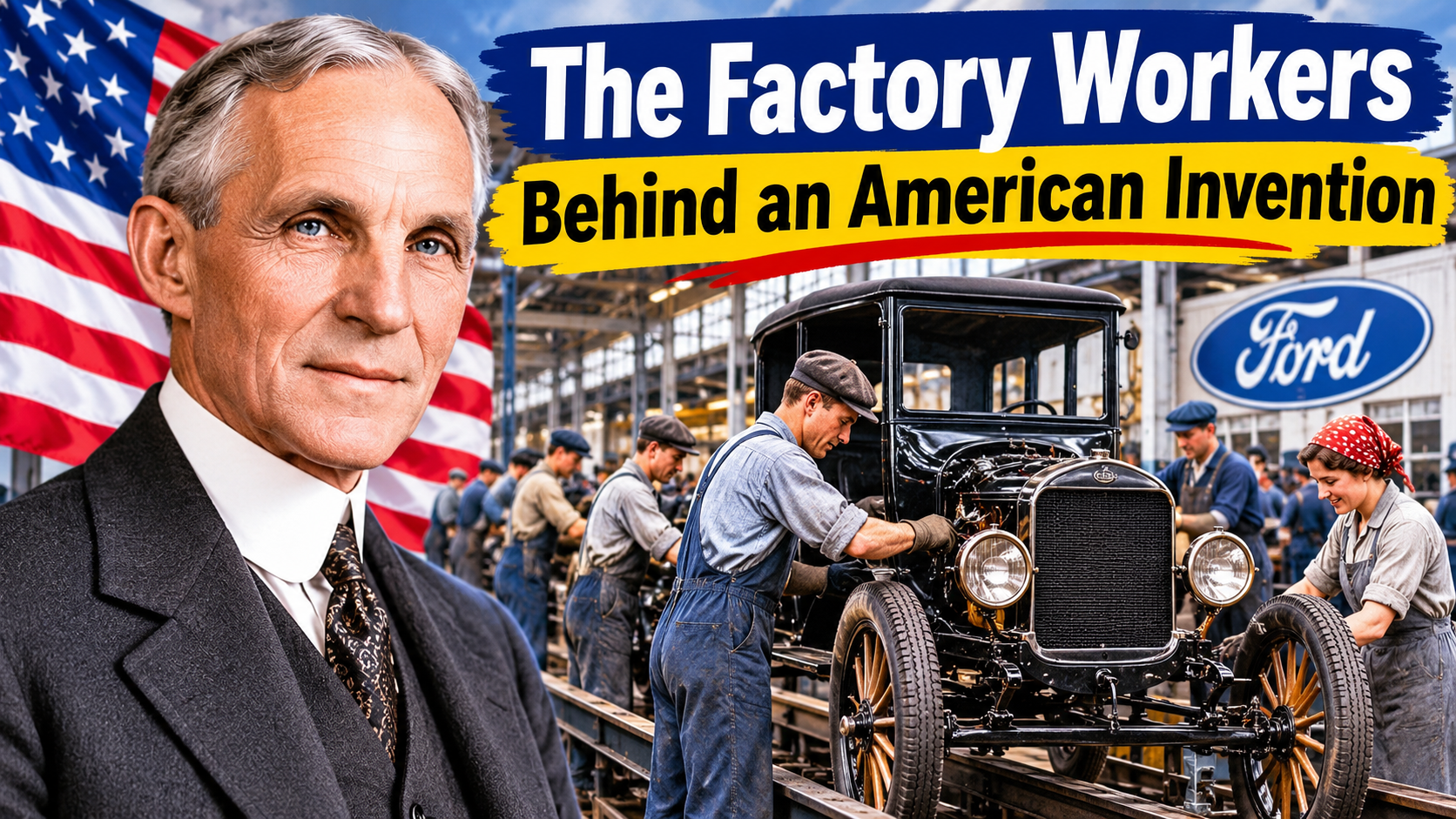
In the early twentieth century, American factories were changing the way products were made. Machines were becoming more advanced, industries were growing, and automobiles were beginning to attract the attention of ordinary Americans.
But behind one of the most important changes in American manufacturing was something that rarely received enough attention: the work of ordinary factory employees.
In 1913, workers at the Ford Motor Company’s Highland Park factory in Michigan helped transform automobile production through a new manufacturing method known as the moving assembly line. Their work contributed to a change that would influence factories across America and eventually around the world.
A New Era for American Manufacturing
At the beginning of the twentieth century, automobiles were still expensive for many American families. Building a car required considerable time, skilled labor, and careful assembly.
At Ford’s Highland Park factory, workers originally had to spend many hours putting together different automobile components. Production was slower because employees and materials had to move between different stages of manufacturing.
Henry Ford wanted to change this process.
His goal was to make automobiles more affordable by increasing production and reducing the time required to assemble each vehicle.
The solution was not simply to build a larger factory. It was to reorganize how people worked inside it.
The Moving Assembly Line Changes Everything
In October 1913, Ford introduced a moving assembly line for automobile chassis production at its Highland Park plant.
Instead of workers moving around a vehicle to complete different tasks, the automobile’s chassis moved along a production line.
Each employee performed a particular operation before the vehicle continued to the next station.
This system divided automobile production into smaller, more organized steps.
Workers could concentrate on specific tasks rather than assembling an entire automobile themselves.
The results were remarkable.
According to the Library of Congress, the time required to assemble a Model T chassis eventually fell from approximately 12.5 hours to just 93 minutes.
This improvement demonstrated how carefully organized factory work could increase production dramatically.
However, the moving assembly line was not an idea created entirely from nothing. Earlier industries had already used different forms of conveyor systems and divided production tasks. Ford’s achievement was developing and expanding the method into a highly coordinated automobile manufacturing system.
The Workers Who Made the System Possible
The assembly line became famous, but its success depended on thousands of employees.
Every worker had a responsibility. Some installed mechanical components, others handled engines, and others worked with electrical parts, wheels, and vehicle bodies.
One worker might perform a task that seemed small, but that task was necessary for the next employee to complete their part.
The Henry Ford Museum preserves photographs showing employees assembling magnetos at the Highland Park factory in 1913.
Some women worked in the coil-manufacturing department. Their responsibilities included winding wire around iron cores and placing assembled components into wooden boxes.
These photographs provide an important reminder that automobile manufacturing involved many different workers, including women whose contributions were part of the production process.
The factory was not successful because of one person’s work alone. It required coordination, training, machinery, planning, and thousands of individual efforts.
The Price of Faster Production
The new manufacturing system increased efficiency, but it also created challenges for employees.
Assembly-line work could become repetitive. Workers often had to perform the same operation continuously while keeping pace with the moving production line.
The pressure was considerable.
According to historical material preserved by The Henry Ford, worker turnover at the Highland Park plant reached approximately 380 percent by late 1913.
This figure reflected the difficulties many employees experienced with the new working conditions.
Ford recognized that retaining workers was becoming an important problem.
On January 5, 1914, the company announced its famous five-dollar daily wage program for qualifying employees, alongside a reduction to an eight-hour working day.
The announcement attracted enormous attention.
Although the wage program came with eligibility requirements and company rules, it became an important moment in American industrial history.
It demonstrated that the relationship between factory productivity and employee wages was becoming a major national discussion.
How the Model T Reached Ordinary Americans
The moving assembly line helped Ford produce automobiles at a much faster rate.
The Model T, introduced in 1908, became one of the most influential vehicles in American history.
From 1908 to 1927, Ford produced more than 15 million Model T automobiles.
As production increased, the company reduced the vehicle’s price, helping more Americans consider automobile ownership.
Cars gradually became more than expensive machines reserved for wealthy families.
They became an increasingly important part of American transportation and everyday life.
The assembly-line method also influenced other industries. Manufacturers realized that dividing complicated production into smaller tasks could make factories more efficient.
The idea spread far beyond automobile manufacturing.
A Legacy Built by Ordinary People
Today, people often associate the moving assembly line with Henry Ford and his business achievements.
His leadership and the company’s engineering decisions were important. However, the history of this manufacturing transformation is incomplete without recognizing the employees who made the system work.
The workers who installed parts, assembled components, operated machinery, and maintained production helped turn an industrial experiment into a practical manufacturing system.
Their individual contributions may not have made headlines, but together they changed the way American products were manufactured.
The story of the Highland Park factory reminds us that major innovations are not always the work of a single inventor or business leader.
Sometimes, progress happens because thousands of ordinary people perform difficult jobs, solve practical problems, and work together toward something larger than themselves.
The moving assembly line became one of America’s most influential manufacturing developments.
And behind that achievement stood the factory workers whose hands helped move American industry into a new era.
Sources:
1. Library of Congress – Ford Implements the Moving Assembly Line
https://guides.loc.gov/this-month-in-business-history/October/Ford
2. The Henry Ford – America’s Industrial Revolution
https://www.thehenryford.org/collections/explore/sets/detail/americas-industrial-revolution
3. The Franklin Institute – Case Files: Henry Ford
https://fi.edu/en/news/case-files-henry-ford
4. PBS – The Life of Henry Ford
https://www.pbs.org/wgbh/americanexperience/features/henryford/
5. Detroit Historical Society – Ford Highland Park Plant
https://www.detroithistorical.org/learn/online-research/encyclopedia-of-detroit/ford-highland-park-plant
Leave a Reply